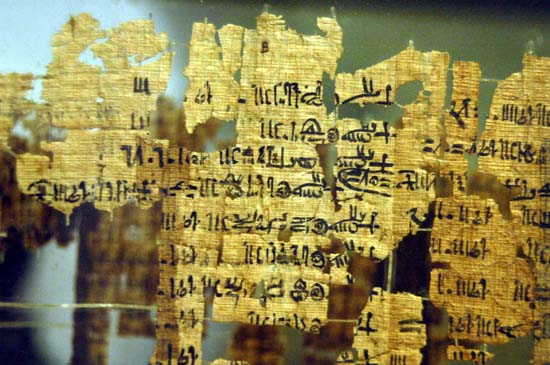
 Turin Royal Canon
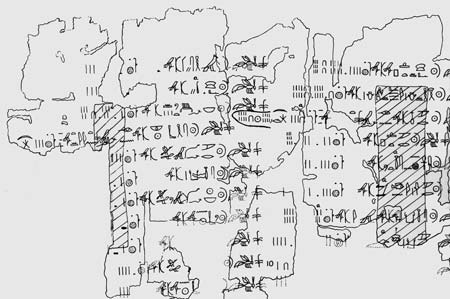
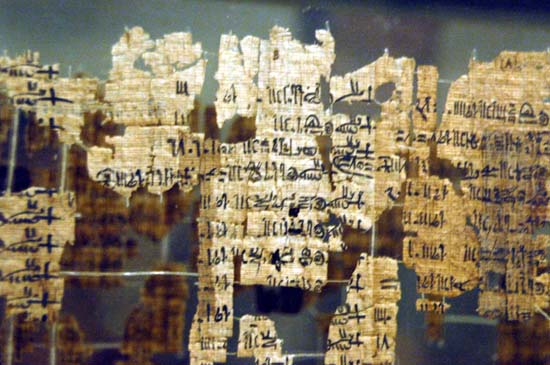
Papyrus dating to the reign of Ramesses II (1279-1213) inscribed in Hieratic with a list of the names of Egyptian rulers (originally numbering about three hundred), evidently copied from a more complete original.
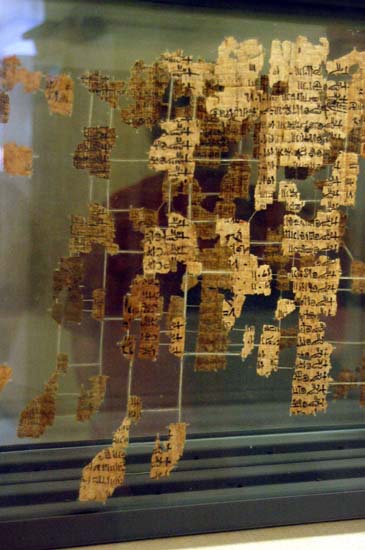
When it was first acquired by Bernardino Drovetti in the early nineteenth century, it seems to have been largely intact, but by the time it had become part of the collection of the Museo Egizio di Turin, its condition had deteriorated. The diligent work of egyptologists Jean-Francois Champollion and Gustavus Seyffarth ensured that the many fragments were placed in the correct order, but many parts are missing.
The list included the Hykos rulers (often left out of other King Lists), although they were not given Cartouches and a hieroglyphic sign was added to indicate that they were foreigners. Apart from the names of each of the rulers, the list also cited the precise duration of each reign, and occasionally provided a summary of the numbers of years that had elapsed since the time of the semi-mythical ruler Memes. There was also an attempt to go back beyond the reigns of known kings and to assign regnal lengths to the series of unnamed spirits and gods who had ruled before the appearance of the human pharaohs. It was presumably this type of document that provided Manetho to with the basis for the history that he compiled in the early third century bc, which has supplied the sequence of dynasties still used by Egyptologists.
Jean-Francois Champollion
 Champollion
was sent to a room that held pieces of papyri that were considered unusable
because they were fragmented. Writing to his brother, Jacques-Joseph,
he reported "on entering the room which I will henceforth call the Mausoleum
of History I was seized by a mortal chill in seeing a table 10 feet in length
covered in its entire expanse with a bed of debris of papyri at least half
a foot deep". The papyri had fragmented during their journey from Egypt
to Italy and had been largely complete when Drovetti purchased it.
Over the coming months he wrote "I have seen roll in my hand the names of
years whose history was a totally forgotten; names of gods who have not
had alters for fifteen centuries... the last refuge of a memory of a king
who in his lifetime perhaps found himself cramped in the immense palace
of Karnak".
Champollion
was sent to a room that held pieces of papyri that were considered unusable
because they were fragmented. Writing to his brother, Jacques-Joseph,
he reported "on entering the room which I will henceforth call the Mausoleum
of History I was seized by a mortal chill in seeing a table 10 feet in length
covered in its entire expanse with a bed of debris of papyri at least half
a foot deep". The papyri had fragmented during their journey from Egypt
to Italy and had been largely complete when Drovetti purchased it.
Over the coming months he wrote "I have seen roll in my hand the names of
years whose history was a totally forgotten; names of gods who have not
had alters for fifteen centuries... the last refuge of a memory of a king
who in his lifetime perhaps found himself cramped in the immense palace
of Karnak".
Among the remains he found 50 pieces of a manuscript he dubbed the 'royal canon'. The Turin Royal Canon, as it is now known, lists over 300 Egyptian rulers. The list includes foreign rulers, excludes others and has the length of reigns. Even more staggering is that he recognized the importance of this document, to establish a chronology, with his unique ability to translate - without which these scraps of history would have been lost forever. No other pieces of the papyri could be found, and this has caused gaps in the list, he wrote "I confess that the greatest disappointment of my literary life is to have discovered this manuscript in such a desperate state. I will never console myself - it is a wound which bleed for a long time".
| Sources |
|
Museo Egizio di Torino, Italy.