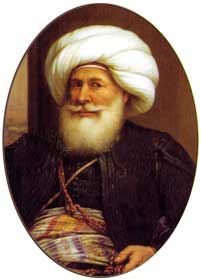
 Pasha Muhammad Ali
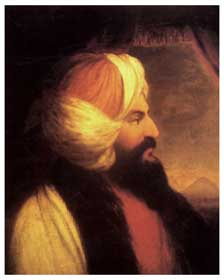
 Bernardino Drovettiwho held his post
as Consul-General from 1810 to 1815 and again from 1820 to 1829. An
officer in the French army who was appointed Consul-General of France in
Egypt and virtually acted as Muhammad Ali's military adviser and reorganized
his army. He began to search for and gather ancient finds (his first
collection was later housed in the
Egyptian Museum in Turin
(Museo Egizio di Turino), where it was added to Vitaliano Donati's
collection). He took part in excavation campaigns and exploratory
expeditions, and also hired a veritable army of agents and assistants
throughout the country to help him find antiquities.
Bernardino Drovettiwho held his post
as Consul-General from 1810 to 1815 and again from 1820 to 1829. An
officer in the French army who was appointed Consul-General of France in
Egypt and virtually acted as Muhammad Ali's military adviser and reorganized
his army. He began to search for and gather ancient finds (his first
collection was later housed in the
Egyptian Museum in Turin
(Museo Egizio di Turino), where it was added to Vitaliano Donati's
collection). He took part in excavation campaigns and exploratory
expeditions, and also hired a veritable army of agents and assistants
throughout the country to help him find antiquities.Henry Saltwas one of the most indefatigable diplomats. He arrived in March-1816 as British Consul-General, replacing Colonel Ernest Misset. Salt managed to gather enough material to sell 3 collections of ancient finds. -- Johann Ludwig Burckhardtwas an outstanding figure among the various scholars and researchers active in Egypt at that time. Calling himself Ibrahim ibn Abdallah, known as 'the Sheik' but actually a Swiss from Lausanne. He was a legendary explorer who discovered the city of Petra in Jordan and the Temple of Ramesses at Abu Simbel. In order to be able to travel more freely and venture into regions off limits for non-Muslims, Burckhardtt converted to Islam and adopted Arabic language and customs. -- William John Bankes, an English traveller and collector from Kingston Lacy in Dorset, who played a role in the decipherment of hieroglyphic script and travelled at length in Upper Egypt and Nubia; he gathered an important collection of finds and, in 1818, discovered the famous King (or Abydos) List in the Temple of Ramesses II at Abydos. -- Giovanni Finatifrom Ferrara (Italy), led an adventurous life - after deserting Napoleon's army he converted to Islam and took the name of Muhammad, serving in the Pasha's army. He was a guide for many European travellers, including Bankes; he also accompanied Belzoni on his second journey to Upper Egypt and Belzoni's wife Sarah on her visit to the Holy Land. -- Giuseppe Forni, Milanese chemist, went to Egypt as the manager of a nitrate factory at Bedrashen (near Cairo). To study the geological features of the region, in 1819 he made a trip on the Red Sea following the same route taken a year earlier by Belzoni during his exploratory trip in search of the lost city of Berenice. -- Giovan Battista Brocchifrom Bassano (Italy), following Naturalist interests, inspired this geologist who travelled at length in Egypt, gathering his scientific observations in a long travel journal published in five volumes.
--Enegildo Fredianifrom Serravezza (Italy) took part in important expeditions in the interior: he went to the Siwa Oasis with Von Minutoli and was in Sennar with Ismail Pasha.
--Alessandro Ricci(Sienese physician) gained quite a reputation as an illustrator for the most important researchers and travellers of the time - Belzoni, Bankes, Champollion and Rosellini - and also gathered a collection of finds that were later put in the Albertinurn in Dresden and the Archaeological Museum in Florence.
--Giovanni Battista Caviglia, a Genoese merchant marine, participated in a series of digs and researches in the Pyramid of Cheops and was also fundamental in clearing the sand from the Sphinx at Giza. -- Girolamo Segato, from Belluno (Italy), was a singular figure: a cartographer, artist and scientist who became famous for having discovered a method for 'petrifying' animal tissue, lie explored and surveyed vast territories in Upper Egypt and Nubia, and also visited the Siwa Oasis on behalf of Baron Von Minutoli. -- Antonio Scottofrom Genoa became the personal physician of Ibrahim Pasha. Giuseppe Bokty (Consul-General of Sweden) from Trieste (Italy). Carlo de Rossetti(Consul-General of Austria) from Trieste (Italy). Frederic Cailliaudgeologist from Nantes. Jean-Jacques Rifaud, sculptor from Marseilles, who worked in Egypt for 40 years, making more than 4,000 drawings. Antonio Lebolo, adventurer.
- This was the situation in Egypt in the early 19th century - just having
emerged from the long period of Ottoman domination in the quest for
independence, while at the same time becoming subject to the pressure and
influence of Western culture - when the Giovanni Battista Belzoni arrived in
June 1815. Belzoni was not a military man like Drovetti, nor a diplomat like
Salt; he did not have Burckhardt's particular skills, was not an artist like
Rifaud, and did not possess Bankes's family patrimony. Furthermore, he was
not even an adventurer in the sense that Finati or Lebolo were. "Belzoni was
a born traveller, just as others are born poets, engineers or astronomers,"
Depping wrote, going on to add details about his physique: "He was of
colossal stature, shaped like Hercules. He had broad shoulders, his head was
covered with long hair and his features were gentle Abbe Lodovico Menin, the
author of a famous biography of Belzoni, gives a brief psychological profile
of his subject: "His character was similar to his physical constitution.
There was something energetic and resolute about his movements and words; he
requested with audacity, demanded with obstinacy..."
- Giovanni Battista Belzoni
-
- Birth to Egypt
-
1st Journey (30-June-1816 to 15-December-1816)
2nd Journey (20-February-1817 to 21-December-1817)
3rd Journey (28-April-1818 to 18-February-1819)
The Obelisk at Philae
The Journey to the Oaths of Jupiter Ammon
Return to Europe - The Narratives is Published
- Final Journey
Personality and Reflection - From Birth to Egypt
- Born on 5-November-1778, "My native place is the city of Padua: I am of a Roman family, which had resided there for many years." Giovanni Battista Bolzon (who later changed his family name to Belzoni) began to work as a barber in his father's shop. He moved to Rome, then to Paris and Holland, and studied hydraulics. In 1803, together with his brother Francesco, he went to England where he stayed for 9 years and even became a British citizen. In order to make a living he displayed fountains he had invented at fairs or exhibited his strength at the Sadler's Wells Theatre, where he was a 'strong man,' a 'Patagonian Samson.' His most famous act was the one called the 'human pyramid,' in which he lifted about ten persons and carried them around the stage. At that time he met Sarah Banne (from Bristol) his future wife. In 1815 Belzoni, after a tour of performances in Spain, Portugal and Sicily, went to Malta where he met Ismael Gibraltar, an emissary of Muhammad Ali, who at the time was undertaking a programme of agrarian land reclamation and important irrigation works.
- Belzoni offered his services as an expert in the construction of a
hydraulic machine and he boarded the brig Benigno sailing for Alexandria.
Once in Cairo, Belzoni made friends with Bernardino Drovetti, whom he called
"Highly Esteemed Sir and true friend," as some letters (three of which are
dated August-1815) written to the Piedmontese (north-east Italy including
Turin) could testify. Drovetti supported him and recommended him to the
Swedish Consul-General Bokty, whom the Pasha had charged with helping
scientists and artists who had just arrived in Egypt, but relations between
the two soon deteriorated: "No sooner had Mr. Belzoni arrived still dreaming
of what had never occurred, and without any apparent reason, he told me in
no uncertain terms and repeatedly that he had no intention whatever of
depending upon me for the slightest thing." In any case, Belzoni managed to
show the Pasha how his hydraulic machine worked, but since a snag occurred
during the demonstration, and perhaps because of self interest in the
pasha's court, his project was not approved and he found himself without a
job. Fortunately, among the Europeans in Cairo whom he had met, was the
famous Burckhardt, a figure who always had a deep influence on Belzoni.
Burckhardt had found out that near Qurna (West Thebes), in the second court
of the Ramesseum - the mortuary temple of Ramesses II that Strabo called the
Memnonium and Diodorus Siculus called the Tomb of Ozymandias - there were the remains of two granite colossi. One of them
a bust, that other travellers such as Norden and Hamilton, had mentioned
earlier was in an excellent state of preservation and had already attracted
the attention of the French and, in 1814, of the English Army officer Henry
Light. This monolith, which weighed about seven tons and was
seven-and-a-half metres tall,'" was called 'Young Memnon' by travellers.
after Homer's mythical hero, the king of Ethiopia and the son of Eos and
Tithonus who was killed b Achilles while coming to the aid of the Trojans.
But the statue really was a portrait of Ramesses II. Burckhardt had already
tried, in vain, to persuade Muhammad Ali to offer the statue as a gift to
the King of Eng land, and had then spokes with the new British
Consul-General, Henry Salt, managing to persuade him to remove the bust to
send it to the British Museum Belzoni, who by then has been in Egypt one
year, was not yet personal interested in the archaeological treasures of
that country,'' but was unconsciously fascinated by them: the first tours he
tool upon his arrival in Cairo were, in fact, of the pyramids of Dahshur and
Giza. Although he was now unemployed, he decided to stay in Egypt, but his
lack of money soon clashed with this desire. Therefore, the possibility of
transporting the statue came at just the right moment, and he seized upon
the opportunity, immediately. He declared he would certainly be able to
transport the colossus, so that Salt entrusted Belzoni with this commission,
stating that the latter was gifted with "...great talents and uncommon
genius for mechanics. However, Belzoni's work for the British Consul-General
was to cost him his relationship will Drovetti.
- The 1st
Journey (30-June-1816 to 15-December-1816)
Once lie had managed to obtain the firman [a pass or permit issued by the Pasha to consuls and their agents] necessary to carry out research and excavations, on 30-June-1816 Belzoni embarked at Bulak, the river port of Cairo, and sailed to Thebes.''" In theory. since Belzoni had the pass, the kashefs (local functionaries who represented the Pasha in the various districts) should have helped bun by providing him with the labourers he needed for his work. But the truth was, in those areas far from the influence of the central power, the kashefs often became little tyrants vested with absolute power, so that getting aid from there was generally a question of luck. Already during his first journey Belzoni manifested all his skills, not only on a technical level, but in time art of dealing with the locals as well, both authorities and simple peasants. "He possesses, to an astonishing degree, the secret of conciliating the Arabs and literally makes there do whatever lie chooses," wrote Colonel George Fitzclarence" who had observed Belzoni at work. This ability not only consisted of knowing how to move huge piles of stones, but also of managing to get the locals to work, since these people often had no notion of money, or believed Belzoni wanted to steal what: they thought, were hidden treasures. He also had to be able to thwart the manoeuvres of his adversaries, as well as understand whether a difficult problem should be solved by offering gifts or by manifesting the utmost determination. But difficulties (lid not bother the Paduan: "A mean built like Belzoni, with a firman, money and a cane, certainly knew how to instil fear in the Egyptian fellahs... ." After overcoming many au obstacle, on 27-July-1816 Belzoni managed to gather together about 80 men and begin moving the statue, using only levers, trollies and palm fibre rope. A sort of sledge was built, and the monolith was lifted onto it with four levers. Unwittingly, Belzoni used a method similar to the one the ancient Egyptians themselves had adopted to move these very colossi, as can be seen in a wall relief discovered in a 12th Dynasty tomb at Bersha.
The heat was unbearable and Belzoni, who spent the nights inside the Ramesseum, the stones of which were too hot even to touch, was exhausted and continuously disturbed by bodily discomforts. Despite all these difficulties, in addition to the huge technical problems he had to face, on 12-August-1816, after only fifteen days, the 'young Memnon' had been transported 1,200 metres and was on the edge of the Nile, ready to be placed on board. Belzoni had succeeded in doing what Napoleon's army had not been able to achieve. "It is almost two miles from the Palace known as the Memnonimn to the Nile," Belzoni wrote to his relatives, "and the already mentioned size of this Colossus was the reason why it was preserved, since it had fallen face down and remained in this position until the time of the French, who tried to cut it into two pieces by placing a mine in its chest so they could transport it; but then, fearing the facial features would be ruined, they abandoned the undertaking. The mission was accomplished, but Belzoni was overcome with a thirst for adventure: while waiting for the vessel that would take the colossus to its destination, lie decided to make an excursion in Nubia as far as the Second Cataract, a region that at the time was still almost unknown, having been visited by very few travellers, including Burckhardt and Bankes. On 24-August he arrived at Aswan (ancient Syene), and then at Abu Simbel, where the splendid Temple of Ramesses II stood. It had been discovered four years earlier by Burckhardt, half buried in a huge pile of hardened sand about 20 metres high. No one had succeeded in penetrating the interior, where the locals believed a fabulous treasure lay. Belzoni decided to begin removing the sand from the temple facade, but immediately had to face a series of difficulties. not only with the local authorities but also with the inhabitants who, not knowing the value of money, saw no reason why they should perform such hard labour. Drovetti, who had visited Abu Simbel a few months earlier, had had the same problems, but unlike Belzoni, had not succeeded in getting the locals to cooperate with him and had had to leave the site without accomplishing anything appreciable.
-
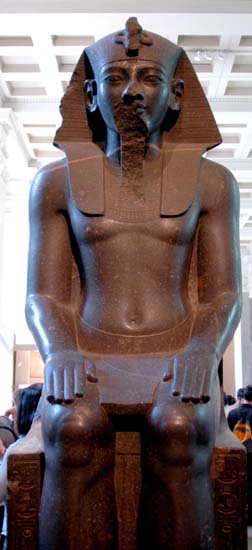 After
a short visit to the Second Cataract, the Paduan began excavation of the
temple. But the undertaking proved more difficult than expected, and the
lack of money and food forced him to suspend work after seven days of hard
work. So he decided to return to Thebes and see to getting the 'young Memnon'
on its way. During the return voyage lie stopped at Philae, not neglecting
to take possession, on behalf of the Consul-General of His Majesty of
England, of a perfectly preserved obelisk with inscriptions that stood in
front of the Temple of Isis. This find proved to be of the utmost importance
in the decipherment of hieroglyphic script, but it also triggered a long
series of problems with Drovetti later on. While still waiting to embark the
colossus, Belzoni began some digs at Karnak, in the Temple of Mut precinct,
where lie found a group of statues, six of which were intact: they were all
portraits of the goddess Sekhmet except for one. in white quartzite, that
depicted the pharaoh Setlios II. At the same time, Belzoni also carried out
his first research on the other bank of the Nile, at Biban el-Moluk [Valley
of the Kings], where he discovered the tomb of the Ay, lie carved the
following inscription over the gateway: DISCOVERED BY BELZONI - 1816.
He was becoming more and more eager to begin transporting the collection of
antiquities lie had gathered during this first trip, but an order prohibited
transporting finds along the Nile, and the boatmen refused to cooperate with
him, stating that the material was too heavy to be loaded. This problem was
solved by Khalil Bev, Muhammad Ali's son-in-law (he had married the Pasha's
daughter, Nazli) and governor of the province of Upper Egypt. In only five
days all the material was loaded onto a boat. On 20-November he left Thebes,
arriving at Cairo on 15-December-1816. The 'young Memnon' colossus then
continued its journey to Alexandria, where it arrived on 10-January-1817 .
It was then finally sliipped to London, where it can be admired in the
Egyptian Sculpture Gallery of the British Museum. Belzoni did not spend much
time in the capital: although Salt had invited him to take part in the
excavations of the Great Pyramid of Giza.
After
a short visit to the Second Cataract, the Paduan began excavation of the
temple. But the undertaking proved more difficult than expected, and the
lack of money and food forced him to suspend work after seven days of hard
work. So he decided to return to Thebes and see to getting the 'young Memnon'
on its way. During the return voyage lie stopped at Philae, not neglecting
to take possession, on behalf of the Consul-General of His Majesty of
England, of a perfectly preserved obelisk with inscriptions that stood in
front of the Temple of Isis. This find proved to be of the utmost importance
in the decipherment of hieroglyphic script, but it also triggered a long
series of problems with Drovetti later on. While still waiting to embark the
colossus, Belzoni began some digs at Karnak, in the Temple of Mut precinct,
where lie found a group of statues, six of which were intact: they were all
portraits of the goddess Sekhmet except for one. in white quartzite, that
depicted the pharaoh Setlios II. At the same time, Belzoni also carried out
his first research on the other bank of the Nile, at Biban el-Moluk [Valley
of the Kings], where he discovered the tomb of the Ay, lie carved the
following inscription over the gateway: DISCOVERED BY BELZONI - 1816.
He was becoming more and more eager to begin transporting the collection of
antiquities lie had gathered during this first trip, but an order prohibited
transporting finds along the Nile, and the boatmen refused to cooperate with
him, stating that the material was too heavy to be loaded. This problem was
solved by Khalil Bev, Muhammad Ali's son-in-law (he had married the Pasha's
daughter, Nazli) and governor of the province of Upper Egypt. In only five
days all the material was loaded onto a boat. On 20-November he left Thebes,
arriving at Cairo on 15-December-1816. The 'young Memnon' colossus then
continued its journey to Alexandria, where it arrived on 10-January-1817 .
It was then finally sliipped to London, where it can be admired in the
Egyptian Sculpture Gallery of the British Museum. Belzoni did not spend much
time in the capital: although Salt had invited him to take part in the
excavations of the Great Pyramid of Giza. - Caviglia's excavation of the Sphinx at Giza was already being
successfully carried out, and Belzoni declined the offer: "[...] as I
thought it would not be right to attempt to share the credit of one, who had
already exerted himself to the impost of his power, I declined. Besides, it
would have been a poor victory on my part to enter into the field after the
battle had been fought, and conquest gained by another. I contented myself,
therefore, with hoping for a better opportunity to try my skill, independent
of any one. Driven by this urge, he made preparations for another journey to
Upper Egypt and Nubia.
- The
2nd Journey (20-February-1817 to 21-December-1817)
After leaving his wife Sarah at the home of friends, Belzoni again set off for Bulak on 20-February-1817 with the aim of stopping at Karnak to make excavations, but above all of returning to Abu Simbel to resume work on removing the sand from the great temple. His travelling companions were Henry William Beechey, Salt's secretary, and the Greek excavator Giovanni d'Athanasi, Salt's agent. When lie arrived at, Karnak he realized that two of Drovetti's agents had got there before him. By offering gifts to the local kashef, they had obtained permission to set up several excavation yards in places where he himself had worked the previous year. Forced to play the role of spectator, which was against his nature, Belzoni decided to explore the necropolis of Qurna, "the burial-place of the great city of a hundred gates, { in search of papyri and mummies. In those narrow underground passageways illuminated by dim torches, with the stench of the piles of decomposing mummies that produced "a vast quantity of dust," the work was exhausting. This time Belzoni did not, miss any opportunities and managed to purchase, from an inhabitant of Qurna, two stupendous bronze vases covered with hieroglyphs, which are now kept in the British Museum. In the Temple of Mut precinct at Karnak, he also found a group of statues. Four of them, representing the goddess Sekhmet, were in a good state of preservation and were later sold to Count Louis Nicolas Philippe Auguste de Forbin, the director of the Louvre. Belzoni also found a red granite bust of a colossus of Tuthmosis III and an arm from the same statue. Again at Karnak, he removed the famous 'altar with the six divinities from the Temple of Montu, and in the Theban necropolis managed to salvage the celebrated lid of the sarcophagus of Ramesses III, which is now at the Fitzwilliam Museum, Cambridge. Unfortunately, this lucky series of important finds was interrupted by the governor of Upper Egypt, who, under pressure from the French and most probably from Drovetti himself, prohibited the English from gathering ancient finds. There was nothing left for him to do but abandon the digs - at least for the moment - and go to Abu Simbel to resume the work that had been interrupted the year before, particularly since the British Consul Salt had encouraged him to finish the operation.
- On May 23 Belzoni left Thebes and went up the Nile to the island of
Philae, where lie was joined by two English Navy captains, James Mangles and
Charles Leonard lrby, one of Salt's emissaries, Giovanni Finati from
Ferrara, and his wife Sarah." On 29-June the group reached Abu Simbel. Here,
with the help of Beechey, the two naval officers and Finati, work was
resumed, despite the difficulties due to the torrid heat and above all the
hired labourers. After about a month, on August 1, Belzoni finally
succeeding in entering the temple, which had been inviolate for centuries.
Inside, the temperature was over 50°C. However, the group's joy was tempered
by the fact that not only was there no sign whatsoever of 'treasures,' but
even the small objects they found were of little value. Mangles and Irby
compiled an accurate inventory of all the finds'' and drew a plan of the
temple with the following annotation: "Opened 1-August-1817 by desire of Mr.
Salt." To commemorate this memorable exploit, Belzoni carved his name and
those of his fellow adventurers, as well as the date, on the north wall of
the temple sanctuary, where the statues of Amun-Re, Re Harakthi, the deified
Ramesses II and Ptah sat. Such carving was common practice in those days as
unequivocal demonstration of the ownership of a monument or the paternity of
a discovery." While the opening of the temple at Abu Simbel was undoubtedly
important from a historical and scientific standpoint, judged from the
rapacious standards of that period it was quite disappointing. Belzoni
decided to resume his research in the Valley of the Kings, where he had
found his first tomb the previous year. Here he had the good fortune to
find, in the space of a few days, four extremely important tombs (including
the ones of prince Montuherkepshef and the pharaoh Ramesses I, and on
18-October-1817 he discovered another, intact tomb that proved to be one of
the largest and most beautiful ever found in Egypt.
- This tomb, which Belzoni later called the 'tomb of Apis, belonged to Sety I, the father of Ramesses II, but since the Italian explorer could not read hieroglyphic script lie thought it belonged to a hypothetical pharaoh called 'Psammethis'." The tomb was decorated with extraordinarily beautiful polychrome paintings and a series of marvellous bas-reliefs. In the funerary hall was a splendid alabaster sarcophagus with inscriptions from the Book of the Gates." The sarcophagus was the most beautiful archaeological object Belzoni found in his entire career, but from a financial standpoint it did not reward him with the remuneration he had expected. Negotiations for the sale of the sarcophagus to Drovetti came to nothing, and the piece was also rejected by the British Museum because the price was considered too high. It was finally purchased by Sir John Soave, who put it in his private museum in Lincoln's Inn Fields, London, where it is still kept." It took only ten days for Belzoni to finish excavation of the tomb which, had it been carried out with modern-day techniques, would have required years of work. With the help of the Sienese physician Alessandro Ricci he made a survey of the main paintings as well as casts of the bas-reliefs, which numbered more than 800.
While Ricci proceeded with the work, Belzoni returned to Cairo, where he learned of Burckhardt's death. Taking advantage of the stay in the capital, he decided to try his hand at another exploit that would enhance his reputation: to reveal the mystery of the Pyramid of Khephren, which according to Herodotus had no inner chambers. Once in Giza, Belzoni carefully inspected the monument and noticed that a section of stones on the north side was not so consolidated. A few days later, after asking for a loan from the Briggs & Walmas bank in order not to depend on Salt, Belzoni hired about 80 Arab labourers and began the excavation. The first attempt to enter the pyramid failed, but after making comparisons with the Pyramid of Cheops and drawing some logical deductions, he finally found the entrance of the access passage way. On 2-March-1818 Belzoni, accompanied by Enegildo Frediani, reached the burial chamber, but to his dismay he found only a large empty sarcophagus. As was his custom, he made a thorough survey of the pyramid and, to record the historic event, did not neglect to carve his name and the date in the burial chamber, which the English called Belzoni's Chamber for a long time.
- A 12th-century Arabic inscription in the chamber revealed that the
pyramid had already been violated 600 years earlier by the son of the famous
Saladin, but since there was no collective memory of this, Belzoni had every
right to be considered the first true discoverer of the pyramid. To
celebrate the event, the English struck a medal with the bust of Belzoni on
one side and the Pyramid of Khephren on the other, bearing the inscription:
OPENED By G. BELZONI - MARCH 2nd 1818.
- The
3rd Journey (28-April-1818 to 18-February-1819)
Immediately after opening the Pyramid of Khephren, Belzoni left Cairo and returned to Thebes. Here he realized that it was practically impossible for him to undertake further research: all the best excavation areas had been divided between Salt and Drovetti, so that he had to resign himself to excavating in an area that Salt had abandoned, situated between the Ramesseum and Medinet Habu. Luck was on his side: he found a splendid statue about three metres high of Amenhotep III - the colossal head of which he had found earlier in the ruins of Karnak - and some lion-headed statues of Sekhmet similar to the ones found at Karnak years earlier. This was his last excavation. Since there were no other zones where he could work, he decided to finish the casts and surveys in the tomb of Sety I. which everv-one now called Belzoni's tomb.' Belzoni had planned to join his wife in Jerusalem when he had finished this long and laborious operation, but he changed his mind and decided to make the long journey in the desert toward the Red Sea, intrigued by an account Cailliaud had written. The Frenchman, an expert in mineralogy who had visited this area on behalf of Muhammad Ali, claimed he had found some sulphur and emerald mines and the ruins of ancient Berenice, the port built by Ptolemy II Philadelphus. Belzoni left Edfu on 23-September with sixteen camels, accompanied by Beechey and Ricci, and retraced Cailliaud's steps. At Wadi Miah he found the small temple built by Sety I already described by Cailliaud.
- Then, proceeding along the track, he and his companions arrived at Mount Zabara and then at the ruins Cailliaud had described, which, upon examination, proved to be nothing more than the remains of a modest mining village. Undaunted by this, since he was convinced of the possibility of finding the real city of Berenice. Belzoni headed south once again, following the indications provided by the famous cartographer D'Anville, whose map of Egypt was a favourite with the travellers of the time. In the end, his persistence and faith paid off: when he got to the present-day Ras Banas peninsula, he realized that he had finally found the ruins he had looked for, half buried in the sand. The lack of water and food forced Belzoni to make a brief stop. and he had to begin the return journey on 10-October. But instead of going back by the same route, that is, heading north and then skirting the Red Sea, he ventured further northwest into the interior, arriving at the site of Sakiet, where he could survey another small temple with Greek inscriptions that also had been described in Cailliaud's account. He then went back to the track he had used on his way to Berenice, arriving at the Nile on 23-October. Altogether, the journey to the Red Sea had lasted 40 days, "which I hope were not uselessly employed," Belzoni noted in his travel journal. The site of ancient Berenice had been discovered, so the expedition was a total success, even though from an economic point of view it proved to be a liability.
- The Obelisk at Philae
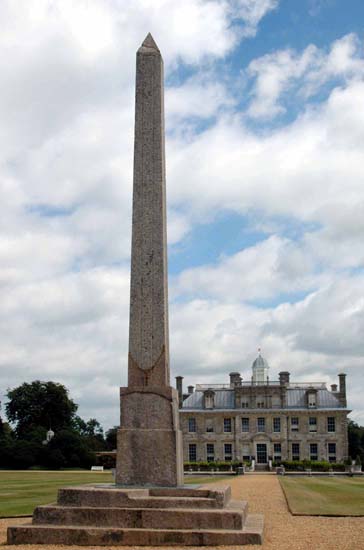 At
Qurna, Belzoni met Salt and Bankes, who had arrived from Cairo and
were on their way to Abu Simbel, accompanied by Baron Sack and the
illustrator Linant de Bellefonds. On this occasion Bankes asked Belzoni to
retrieve the obelisk at Philae that the latter had claimed possession of
during his first journey, as the Englishman had grasped the scientific
value of the monument and wanted to put it in his Kingston Lacy estate in
Dorset. The obelisk, which had been erected around 118-116 BC by Ptolemy
VIII Euergetes II and stood in front of the first pylon of the Temple of
Isis, was to play a major role in the history of the decipherment of
hieroglyphic script, together with the much more famous 'Rosetta Stone.' In
fact, the base of the obelisk had a triple Greek inscription with the text
of a correspondence between Ptolemy and the temple priests, while on the
shaft there was a dedicatory text in hieroglyphics with cartouches of
Ptolemy VIII and his consort, Cleopatra III. The names in the cartouches
were later compared with those found in the Greek inscriptions on the base,
and this was a decisive step forward in the decipherment of hieroglyphic
script. The travellers embarked on 16-November-1818 to begin their voyage up
the Nile. Once at Philae, they split up: Salt and Bankes proceeded to Abu
Simbel, while Belzoni stopped on the island to see to the removal of the
obelisk. The difficulty in transporting this monument was aggravated by the
fact that, once it had been carried to the bank of the Nile and was ready
for embarkation, it slid into the river because the pier built by Belzoni
suddenly caved in. Although everyone thought the obelisk was lost for good,
Belzoni not only managed to retrieve it, but even succeeded in getting it
over the First Cataract without any damage, an incredible feat indeed: since
ancient times the cataract had been considered an insurmountable obstacle
for boats. On 24-December the obelisk was at Luxor, ready to be taken to
Rosetta for shipment to England.
At
Qurna, Belzoni met Salt and Bankes, who had arrived from Cairo and
were on their way to Abu Simbel, accompanied by Baron Sack and the
illustrator Linant de Bellefonds. On this occasion Bankes asked Belzoni to
retrieve the obelisk at Philae that the latter had claimed possession of
during his first journey, as the Englishman had grasped the scientific
value of the monument and wanted to put it in his Kingston Lacy estate in
Dorset. The obelisk, which had been erected around 118-116 BC by Ptolemy
VIII Euergetes II and stood in front of the first pylon of the Temple of
Isis, was to play a major role in the history of the decipherment of
hieroglyphic script, together with the much more famous 'Rosetta Stone.' In
fact, the base of the obelisk had a triple Greek inscription with the text
of a correspondence between Ptolemy and the temple priests, while on the
shaft there was a dedicatory text in hieroglyphics with cartouches of
Ptolemy VIII and his consort, Cleopatra III. The names in the cartouches
were later compared with those found in the Greek inscriptions on the base,
and this was a decisive step forward in the decipherment of hieroglyphic
script. The travellers embarked on 16-November-1818 to begin their voyage up
the Nile. Once at Philae, they split up: Salt and Bankes proceeded to Abu
Simbel, while Belzoni stopped on the island to see to the removal of the
obelisk. The difficulty in transporting this monument was aggravated by the
fact that, once it had been carried to the bank of the Nile and was ready
for embarkation, it slid into the river because the pier built by Belzoni
suddenly caved in. Although everyone thought the obelisk was lost for good,
Belzoni not only managed to retrieve it, but even succeeded in getting it
over the First Cataract without any damage, an incredible feat indeed: since
ancient times the cataract had been considered an insurmountable obstacle
for boats. On 24-December the obelisk was at Luxor, ready to be taken to
Rosetta for shipment to England.
Drovetti, who was carrying out digs in the area, was furious when he saw the obelisk arrive at Luxor. A heated argument ensued, Drovetti's agents beat Belzoni's servant and, armed with rifles, even threatened Belzoni himself. The matter was finally settled without further violence, but it was quite clear that Belzoni could no longer work in Egypt. After collecting the very fragile sarcophagus of Sety I, Belzoni left Upper Egypt for good on 27-January-1819.
- The Journey to
the Oaths of Jupiter Ammon
Belzoni arrived in Cairo on 18-February and went on to Alexandria. Despite his determination to return to Europe, he had to stay in the city for a while to testify at the lawsuit the British Consul Lee had brought against Drovetti and his agents for the incident at Luxor. To complicate matters, the proceedings were temporarily postponed until such time as Salt could return from Abu Simbel.
Belzoni therefore decided to make a journey to the Faiyum and the Western Desert to look for the temple of Jupiter Ammon, whose oracle was one of the most famous in antiquity, having been consulted by Alexander the Great and Croesus, king of Lydia, among others. On 20-April-1819, the Paduan left his wife at Rosetta, took a boat straight to Beni Suef, a town about 80 kilometres south of Cairo, and from there went on into the depression of the Faiyum, heading north in the direction of Lake Qarun to find the famous Labyrinth described by Herodotus and Strabo. Thus, he was able to visit the pyramid complexes of al-Lahun and Hawara, which date back to the 12th Dynasty, quite unaware that the term 'Labyrinth' used by the Classical authors indicated the mortuary temple belonging to the Hawara complex. After passing Medinet el-Faiyum and the ruins of Arsinoe, on 1-May Belzoni arrived at the shores of Lake Moeris (present-day Lake Qarun), which he explored thoroughly. At the western tip of the lake, near present-day Qasr Qarun, he examined the remains of ancient Dionysias. He then crossed the lake to the northern coast, where he found other ruins he thought were those of the Greek city of Koin el-Asl (Bacchias). Skirting the southern coastline, he returned to Medinet el-Faiyum, where he began preparations for his trip in search of the oasis of Jupiter Ammon.
- On 19-May Belzoni left the village of Sedinin and proceeded into the
desert with a small caravan of six camels. Heading west-southwest, he first
got to Tutun, near the ruins of ancient Tebtunis, then el-Garak el-Sultani,
and lastly Ain el-Ruwayan. Still heading west, he passed through the wadi
called Bahr-Balama, 'the valley of the river without water,' where he
thought some rocky tumuli he had spotted were the tombs of the 50,000
soldiers in Cambyses's army who, according to Herodotus, had disappeared in
the desert after a violent sandstorm while attempting to attack the
Ammonites. On 25-May, after six days of travelling, he arrived at the
oasis of Bahariya (described as the 'oasis of El-Cassar'), which he thought
was the oasis of Jupiter Ammon mentioned by Classical authors. Since the
Bedouin camp had found a spring whose water was cold by day and warm at
night, which fitted perfectly with these authors' description of the
Fountain of the Sun near the Temple of Jupiter Ammon, he was even more
convinced he had found the site.
- However, by calculating the direction Belzoni took and the average
distance he could cover per day on camelback, it is evident that he could
never have reached what is today considered the true oasis of Jupiter Ammon,
that is, the oasis of Siwa. On the other hand, a careful reading of his
Narrative and of a letter he sent to Cardinal Ercole Consalvi, clearly
shows that Belzoni himself was perfectly aware of his real geographic
position. He simply believed that the oasis of Jupiter Amnion might
correspond to the oasis of Bahariya. At the end of May, Belzoni began his
return trip, arriving at his starting point, Beni Suef, on 15-June. From
here he went down the Nile, passed by Cairo, which had been struck by an
epidemic of plague, and stopped at Rosetta on 23-June. After settling all
his affairs, packing his collections of finds, and testifying at the trial
against Drovetti's agents, which came to nothing, he set off for Europe in
mid September with his wife. Belzoni landed in Venice around mid November
and had to go through the routine period of quarantine.
- Return to Europe
- On 6-December-1819 the Gazzetta privilegiata of Venice informed its readers that "the celebrated traveller Belzoni" was in town and was about to leave for Padua. It seems that around the middle of December Belzoni was able to see his family again' and pay homage to his home town, to which he had previously donated two splendid diorite statues of the goddess Sekhmet he had found at Karnak, which had been put in the Sala della Ragione, as he had requested. As a token of its gratitude, the city administration struck a medal with the two statues.
- During his brief stay in Padua, Belzoni struck up a friendship with the architect Giuseppe Jappelli, whose 'Egyptian hall' in the famous Caffe Pedrocchi he had inspired, and with numerous figures in the local cultural milieu. In this same period Belzoni advised professor Andrea Renier to purchase three mummies for the Natural History Museum of Padua University for the sum of 400 sequins, which corresponded to about £11,250 today. However, negotiations came to a halt, because the Austrian government would not authorize the deal. In early February, Belzoni said farewell to his relatives and friends and set off for London. On 31-March-1820 the Times informed its readers as follows: "The celebrated traveller Mr. Belzoni has arrived in this metropolis after an absence of 10 years, 5 of which he has employed in arduous researches after the curious remains of antiquities in Egypt and Nubia.
The famous sarcophagus of alabaster, discovered by him in Thebes, is safely deposited in the hands of the British Consul in Alexandria, awaiting its embarkation for England along with the obelisk, 22 feet long, taken by Mr. Belzoni from Philae, above the first cataract of the Nile. Mr. Belzoni's Journal of his discoveries in Egypt and Nubia and the Oasis will be published as soon as possible. The model of the beautiful tomb discovered by Mr. Belzoni in Thebes will be erected as soon as a convenient place shall be found for its reception. After his return to London, Belzoni wasted no time in writing his travel journals, probably aided by his wife Sarah to fill the gaps in his rather poor English. which Byron described as "very prettily broken."
The Narratives is Published- Toward the end of 1820 the well-known London publish John Murray printed
the 1st edition of his work, which was entitled Narrative of the operations
and recent discoveries within the pyramids, temples, tombs and excavations
in Egypt and Nubia; and of a journey to the coasts of the Red Sea, in search
of the ancient Berenice; and another in the oasis of Jupiter Ammon. It was a
quarto volume that ended with his wife's account of her journey to the Holy
Land, Mrs. Belzoni's Trifling Account of the Women of Egypt, Nubia and
Syria. The text was complemented by an atlas, entitled Forty Four Plates
illustrative of the Researches and Operations of Belzoni in Egypt and Nubia,
which presented watercolour drawings, some by Ricci and others by Belzoni
himself. The book was a success with public and critics alike. The
prestigious Quarterly Review wrote the following about Belzoni: "...he may
justly be considered as the pioneer, and a most powerful and useful one, of
antiquarian researches; he points out the road and makes it easy for others
to travel over..."
- A few months later, in 1821, Murray was forced to publish a second edition, which was followed by a third in 1822, in two octavo volumes. Six New Plates were added to the atlas as well. Narrative was immediately translated into French (Voyages en Egypte, et en Nubie, Paris 1821), German (Reise in Aegypt, Nubia. Jena 1821) and later, in 1825, into Italian (Viaggi in Egitto ed in Nubia..., Milan). In his book, Belzoni provides a meticulous description, written in a clear and linear style, of his adventures and discoveries during his sojourn in Egypt, defending himself, at times in an extremely polemical tone, from the calumnies of which he had been a victim. His passionate account offers a vivid picture of Egypt at that time which also contains a wealth of observations. A century later Howard Carter called it "one of the most fascinating books in the whole of Egyptian literature. At the Egyptian Hall at Piccadilly, Belzoni organized a grandiose exhibition of the ancient objects he had gathered in his four years of research. On display were the drawings and casts from the tomb of Sety I, two of the most beautiful chambers of which were reconstructed, the lion-headed statues of the goddess Sekhmet, a model of the Pyramid of Khephren, mummies, and other minor finds.
- Unfortunately, the most precious piece was missing: the alabaster
sarcophagus, which was still in Egypt. On 1-May-1821, the day of the
inauguration, in front of a huge crowd, Belzoni appeared wrapped in mummy
bandages. He soon became one of the most famous figures in London, praised
by the press and sought after in the important salons. He frequented such
illustrious personalities as Sir Walter Scott and Augustus Frederick, Duke
of Sussex, the 6th son of King George III, to whom he dedicated a
dissertation on the hieroglyphs on the tomb of Sety I. During this period,
Belzoni joined the Masonic Chapter of the Royal Arch, which the Duke of
Sussex was also a member. In April 1822 Belzoni left for Russia, where he
was received in St. Petersburg with high honours by Czar Alexander I, who
gave him a ring with a topaz.
- When he returned to England, in early June, the exhibition in
Piccadilly, which had been one of the major attractions in London, had
closed. Many pieces were then sold in a public auction. A few months later,
in autumn, the exhibition was taken to Paris, where it opened - with less
success than in England - just when Champollion's famous
Lettre a M. Dacier announced to the world the key to the mystery of
hieroglyphic script.
- The Final Journey
Egypt may have brought Belzoni glory and celebrity, but it certainly did not improve his precarious financial situation. He had not made much money from his great feats: at Abu Simbel and in the Pyramid of Khephren he had found virtually nothing that recompensed him adequately for his labour, and he still had not found a buyer for the great sarcophagus of Sety I. To make matters worse, the expeditions to Berenice and the oasis of Bahariya had proved to be simply disastrous from an economic standpoint.
- Perhaps it was the need for money and not only the thirst for adventure
that drove Belzoni - again accompanied by his loyal wife Sarah - to set off
for Africa once more to realize an old dream of Burckhardt's - to explore
the course of the Niger river and find the mythical city of Timbuktu.
- After landing in Morocco, he headed south to the city of Fez, where he made his will, entrusting it to Sarah, who in the meantime had decided to return to England. He then tried to continue alone, but because of a war among the local populations he could not cross the Tafilelt region and had to return to Fez. He then worked out a plan to reach Timbuktu from the south. He went back to Gibraltar, took a ship for the Canary Islands and from Tenerife proceeded on the British vessel Swinger for the Gulf of Guinea. When he arrived at Punto Blanco he wrote a letter to his relatives,'' in which he explained his idea of penetrating the interior, and then continued his journey, reaching Cape Coast on 15-October, and then the mouth of the Benin river, in present-day Nigeria, in early November.
From there he planned to reach the Niger river and go northward to the city of Houssa - which the famous explorer Mungo Park had described - and then proceed to Timbuktu. On 22-November, he disembarked from the brig Castor he had sailed on and began his trip up the Niger river, penetrating a region notorious for its great number of endemic diseases. Belzoni, who was already rather old for a traveller in that period, did not manage to escape the fate that had befallen so many other explorers in Africa: at the village of Gwato he suffered a violent intestinal attack. His condition worsened rapidly and a few days later he died, at the aged 45 on 3-December-1823. He was buried under a large tree, six feet under the ground. Mr. Houston read the prayers, after which the riflemen bid the last farewell to his tomb with three salvoes.
- Personality and Reflection
- Belzoni had many opponents and denigrators, his feats and personality seems to stir up a degree of envy, irritation and jealousy. It only seems to be a matter of time before he fell out with his sponsors and acquaintances. It is clear that many of the moneyed 'gentlemen' who travelled in Egypt considered Belzoni to be 'paid help', albeit professional. This may have extended into considering him "not quite a gentleman." - the son of a roman barber from Padua. Belzoni clearly thought himself part of the establishment and, certainly time added to, his feeling of injustice.
- When the Pyramid of Khephren was opened, certain French newspapers
claimed that this feat was due to the Count de Forbin, who had asked Belzoni
to send him a plan of the monument should he succeed in penetrating it. For
his part, de Forbin, who was acquainted with Belzoni and bought some statues
of Sekhmet from him, avoids mentioning his name in his book, Voyage Bans le
Levant, when discussing the monuments the Italian had either discovered or
opened. So it seems Belzoni had to overcome more man-made obstacles than
natural ones, and these were not only the Pasha's corrupt representatives or
uncouth locals: "...in the middle of September-1819," he wrote "we
embarked, thank God! not that I disliked the country I was in, for, on the
contrary, I have reason to he grateful; nor do I complain of the Turks or
Arabs in general, but of Europeans who are in that country, whose conduct
and mode of thinking are a disgrace to human nature.'' Objectively speaking
however we cannot attribute the many injustices Belzoni suffered only to his
rivals envy of his success. Certainly, his pride and extremely independent
spirit were a major factor in his personal relationships, which at first
were quite cordial but inevitably became strained and deteriorated in no
time at all: this was the case with his relations with the Consul Bokty,
then with Drovetti, de Forbin and, lastly, even with Henry Salt. As far as
the complex relationship with Salt is concerned, Belzoni stated many a time,
often openly contradicting himself, that he was totally independent of the
British Consul-General. Although the contract lie had drawn up with Salt,
which is quoted in full in Narrative, was quite clear. Belzoni felt he had
the right to state, quite peremptorily: "I positively deny that I was ever
engaged by him [Salt] in any shape whatever..." When he was departing for
his second journey, he insisted: "The only stipulation I made was that, if I
were successful he should give me an official letter of introduction to the
Society of Antiquaries..."
- In order to open the pyramid of Khephren, Belzoni had asked the banker
Briggs for a loan and ended up refusing Salt's offer of reimbursement,
"...as I thought it would not be fair and right that he should pay for what
he had nothing to do with. Furthermore, when leaving for his third journey,
Belzoni explicitly announced he wanted to gather a collection of antiquities
on his own.' It is interesting to note how he progressively stood aloof from
Salt. Evidently, he did not consider himself a mere agent like so many
others, but, well aware of his worth, felt he had every right to be totally
independent. Though the lack of means forced him to work for those who had
money, in the bottom of his heart he nurtured a deep-rooted spirit of
independence that manifests itself in many passages in his travel journal
and that caused him many problems.
- Belzoni probably never thought of himself as an executor of commissions or a mere expert in mechanics. In his diary he not only made quite detailed descriptions of the monuments he had seen, but also set forth hypotheses and tried to provide interpretations, at times demonstrating considerable acumen. For example, he rightly sensed that the Colossi of Memnon lay in front of a large mortuary temple, that Lake Moeris was a natural lake, and not an artificial one as Herodotus had claimed, and that in ancient Egypt it was the custom to replace the mummy bandages even after burial should they show signs of deterioration. Often, however, lie was unable to go beyond a deep-seated symbolism that strikes its roots in a hermetic tradition influenced by the Renaissance and Kircher and, perhaps, by his initiation into Masonry. For example, in Belzoni's opinion the 'criosphinxes' at Karnak are "lions with the heads of rains, the symbols of the strength and innocence, the power and purity of the Gods, and he interprets the column capitals in the small temple at Edfu as the explicit expression of a contrast made by the builders" to elucidate the destroying power of the cruel god. Again, he interpreted one of the paintings in the tomb of Sety I, which really represents the pharaoh before the offerings table, as "the mystical apron of the serpents," the symbol of regality as well as human weakness. Yet one notes more of an Enlightenment influence in other aspects of his work: the rigour of his observations, the meticulousness of the details, and the simplistic cause-effect logic he applies. His observations, which not only touch upon archaeology but take in botany, zoology and ethnography, stem from a type of curiosity that also bears traces of 18th-century encyclopaedism. Lastly, in his writings one sometimes finds motifs and themes that smack of romanticism: the sepulchral motif, as well as the awareness of the ephemeral duration of civilizations, are experienced as moments of meditation and the transcendence of one's individuality. Opinions about Belzoni are various and controversial. After his return to London and in the years following his death, his achievements were known throughout Europe: an article in the Italian Gazzetta di Milano concerning the inauguration in Padua of a marble medallion dedicated to him.
- In 1830 Sarah Atkins's abridged version of Narrative was published with the title Fruits of Enterprise in the Travels of Belzoni in Egypt and Nubia interspersed with the observations of a mother to her children; the same book came out in France in 1838 and was published... and distributed in all the schools Entretiens d'une mere avec ses enfants sur les voyages de Belzoni [Talks with a mother with her children on the voyages of Belzoni]. However, many people were critical of his rather rudimentary and hasty methods, losing sight of the fact that at that time Egypt was overflowing not only with archaeologists, but with 'antiquities hunters' as well, whose main interest was not to study ancient Egyptian civilization, but rather to gather ancient objects they could dispatch to their respective countries. Even such famous scholars as Champollion and Rosellini, for example, had no qualms about removing some painted bas-reliefs from the tomb of Sety I that Belzoni had merely reproduced in his drawings and casts. Belzoni certainly cannot be considered a scholar or Egyptologist in the modern sense of the word, but neither was he an adventurer or tomb robber.
- He make his discoveries known, as was common: the excavation of the tomb of Sety I is a case in point, a model of correct scientific behaviour that very few persons imitated after his death. Speaking of Belzoni's work in the Valley of the Kings, Carter called the him "one of the most remarkable men in the whole history of Egyptology," and declared: "This was the first occasion on which excavations on a large scale had ever been made in The Valley, and we must give Belzoni full credit for the manner in which they were carried out. There are episodes which give the modern excavator rather a shock, as, for example, when lie describes his method of dealing with sealed doorways - by means of a battering ram - but on the whole the work was extraordinarily good." The famous Who Was Who in Egyptology, published by the Egypt Exploration Society, the entry on Belzoni has the following comment to make: "He cannot be judged by the standards of later excavators such as Petrie, or even Mariette; but must be seen in the context of the period before decipherment; at the start of his career he was neither better nor worse than other contemporary figures, but he later evolved techniques for his work and acquired knowledge that raised him above the general level...". And again: "...in 1818 he opened the Chefren pyramid, showing much more care than Vyse later used on that of Mycerinus...". It is a serious error to judge persons out of their historic context. Belzoni used the methods of his time, in a phase that could be called 'pre-Egyptological.' He was, according to the German Egyptologist Walter Wolf, "the typical representative of Egyptology in its heroic period, but his skill, intuition and determination gave the world marvellous objects that were thought to have been lost for ever.
- Adventures in Egypt and Nubia - Travels of William John Bankes (1786-1855), Patricia Usick
- Belzoni's Travels - Narrative of the Operations and recent discoveries in Egypt and Nubia, Alberto Siliotti
- Description De L'Egypte - Napoleon's Expedition to the discovery of Ancient Egypt, Franco Serino
- The National Trust
- Nubia Twilight, Rupert Hart-Davis
| Sources: |
|
Contact & Feedback : Egyptology and Archaeology through Images : Page last updated on 21-November-2025