- The Church of The Holy
Rude (Rude means Cross), Stirling [Church of Scotland] and the
Star Pyramid
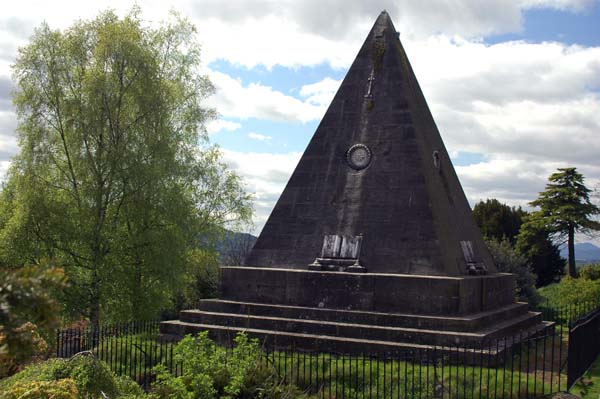
Outside the church is the Valley Cemetery. In past times was the site of jousting tournaments and markets. The Cemetery has a Pyramid, built by William Drummond in 1863.
William Drummond was a land surveyor and nurseryman whose immediate descendants were a well known family in Stirling. They were responsible for a wide range of activities both locally and nationally. These included the establishment of an agricultural museum in the 1830's, an extensive seed and nursery business, exploration in Africa and the Drummond Tract Enterprise, the foremost 19th century publisher of religious pamphlets.
 William
was the eldest son of the well-known Stirling family which included
Peter Drummond and his nephew Henry. He was one of the instigators
of the Valley Cemetery and his obsession with religion can be
seen in the Martyrs' Monument and the Star Pyramid (also known
as Salem
Rock).
William
was the eldest son of the well-known Stirling family which included
Peter Drummond and his nephew Henry. He was one of the instigators
of the Valley Cemetery and his obsession with religion can be
seen in the Martyrs' Monument and the Star Pyramid (also known
as Salem
Rock).
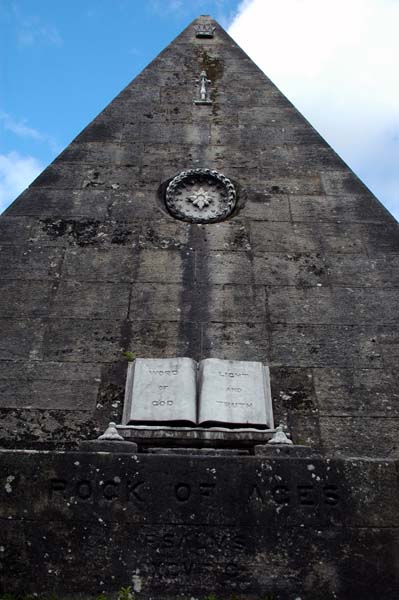
He commissioned the Star Pyramid from William Barclay in 1863 - note the white marble Bibles incorporated by Barclay round the base of the edifice and the names of religious tracts (published by his brother Peter's "Drummond Tract Enterprise"). The Pyramid is dedicated to all those who suffered martyrdom in the cause of civil and religious liberty in Scotland. William planted a Pleasure Garden round the Pyramid, complete with trees and plants. He also paid for five of the six statues seen in various parts of the graveyard and donated trees to be planted round the National Wallace Monument.
This area was laid out as a public pleasure ground by local nurseryman and evangelist, William Drummond. The Star Pyramid, with its texts and emblems, was nearing completion in April 1863, when a bible and the Confession of faith were sealed into a chamber within the structure. It recalls the principles of the Reformation and publicised the famous Drummond Tract Enterprises. - The pyramid is on a raised plinth of 4 steps and has a set of steps leading to it. Each of the faces are very similar. On one face is a circular marble plaque, the text of which is very worn and some of the lower part is readable.
- Each of the sides has (from bottom to top):
- ▪ sunken relief text with a reference to verses from the Psalms:
- ▫ Union Banner, XLV CIII
- ▫ Rock of Ages, XCV
- ▫ Covenant Rest, CXXXII CXLV
- ▫ Thrown of Right, XCVI XCVII
- ▪ marble bible
- ▪ carved circular rosette
- ▪ thistle
- ▪ crown
-
- The first church on this
site was built in the 12th Century and is in the shadow
of
Stirling Castle. The oldest part of the church, still
standing, is the section adjoining the tower which dates
from the 15th Century. It is the second oldest building
in Stirling after the castle, and dates its existence back
to the reign of David I (1124 - 1153) as the parish church
of Stirling.
In 1452, the town and it's wooden church were burned in revenge after King James II murdered the Earl of Douglas.
Inside the church each local craft guild maintained an altar to its Patron Saint. Some burgesses built their own private chapels but only the chapel built for St. Andrew remains. The nave has a fine medieval timber roof, whilst the tower has small pits. These pits are musket and cannon ball marks, probably caused when Parliamentarian General Monck used the tower as a gun battery to attack Stirling Castle in 1651.
A plaque on the floor marks the spot where the infant, King James VI was baptised in 1567. The child was christened in a gold font sent by Elizabeth of England. He was carried into the chapel by the Count of Brienne, as proxy for his godfather the king of France. Queen Elizabeth and the Duke of Savoy were also godparents. The ceremony was conducted by the Archbishop of St. Andrews according to Roman Catholic rites while the Protestant lords stood outside the chapel.
Mary, Queen of Scots, worshipped in the Holy Rude and John Knox preached there, and James VI was crowned there. There are many interesting features to discover in the building and indicating its checkered history.
In 1656, during the fierce religious disputes of the 17th century, the Church was divided into two by a wall – through which the rival ministers of the two halves voiced their disagreements. The dividing wall was only removed in 1936.
Because of its close links with the castle, the church always had the close support and patronage of the Stuart kings (especially in the 15th, 16th and early 17th centuries). It is reputed to be the only church in the United Kingdom other than Westminster Abbey to have held a coronation and still be a living church today.
 |
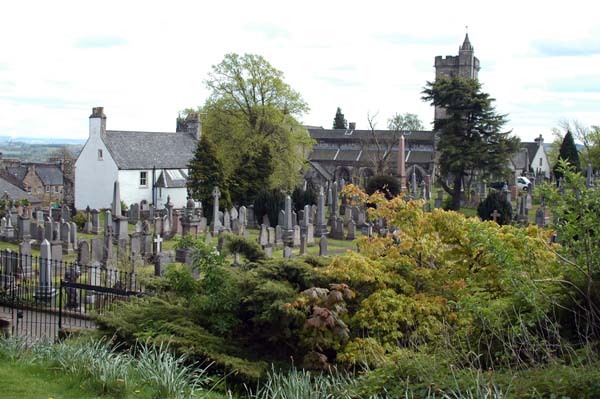 In the graveyard, the graves of merchants and traders are carved with signs and symbols of their craft or trade. |