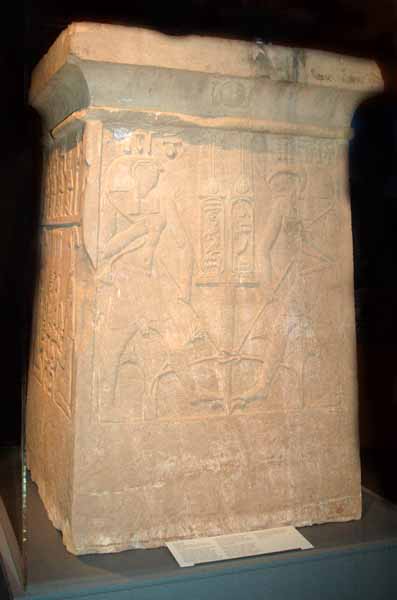
- Sandstone Bark Stand from the Temple of Amun at Naga. Kushinte from the 1st century AD, reign of King Natakamani and Queen Amanitore.
-
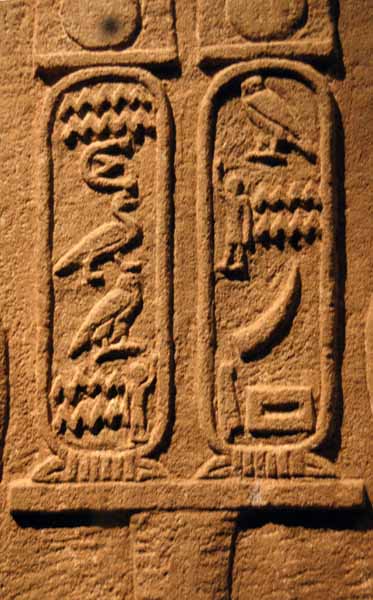
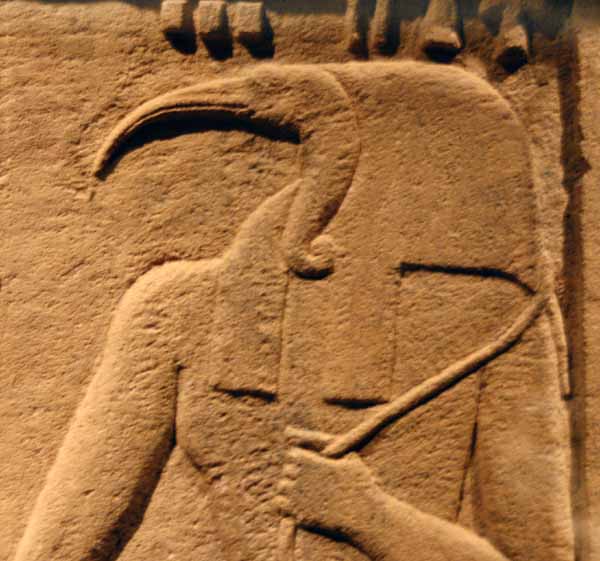
The bark stand survived undamaged in its original position in the sanctuary of the Temple of Amun at Naga. Its shape, proportions and dimensions are almost identical to three altars of King Natakamani and Queen Amanitore found by Richard Lepsius in 1844 in the ruins of a temple at Wad ban Naga. Under the cavetto cornice, the four sides of the altar are decorated in relief. The front side shows the falcon-headed Horns (left) and the ibis-headed Thoth (right) binding papyrus plants around the central hieroglyphic emblem 'septa'. Above this sign two cartouches are placed, crowned by a sun disc and double ostrich feather. The left (northern) cartouche contains the name of King Natakamani, while the right (southern) one the name of Oueen Amanitore. Both are written in Meroitic hieroglyphs. -
The hieroglyphic texts in the horizontal lines above the gods try to imitate Egyptian texts: 'The lord of the eight, the lord of the divine word, given life' and 'The lord of Behedet, the great god, given life' are familiar epithets of Thoth of Hermopolis and Horus of Edfu. This original, an altar of King Atlanersa who lived 650 years before the erection of the Temple of Amun at Naga, stood in a temple at Jebel Barkal. The same motif is repeated on the rear of the altar, this time with Horus on the right and Thoth on the left side; the orientation of the cartouches follows the pattern of the front side with the king to the north and the queen to the south. -
Reliefs on the right and left sides of the bark stand are divided into two registers. Below, two Nile gods are binding the papyrus plants around the sewn with the queen's second - Egyptian - name Meri-ka-ra on the south and the king's second - Egyptian - cartouche Kheper-ka-ra on the north. Above, on both sides, three kneeling male figures with raised arm, jackal-headed and falconheaded, with the same Egyptian hieroglyphic text 'the souls of Pe', are preceded by a kneeling figure of the king and the goddess Meret. This decoration is the standard iconography of bark stands in Egyptian temples since the New Kingdom. -
Egyptian iconography has become an expression of Kushite royal ideology: the unification of Upper and Lower Egypt, symbolized by the sewn motif, is the emblematic sign of political and cosmic order under the control of Kushite kingship. A close parallel to this decoration can be found on the altar in the Great Temple of Amun in Meroe. In perfectly cut relief of a strong three-dimensional effect, these figures show a stylistic modification of the Egyptian prototype into a clearly Meroitic artistic expression with heavy limbs and coarse proportions. The Egyptian and the Meroitic elements merge in an artistic creation in its own right.