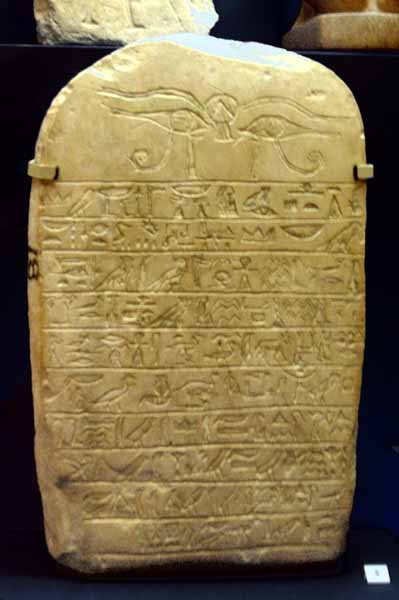
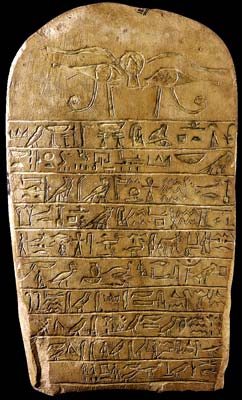
 The
text
reads:
'(1)
A
gift
that
the
king
gives
(to)
Osiris.
Lord
of
Busiris,
the
Great
God,
Lord
of
Abydos.
(2)
and
(to)
Horus.
Lord
of
Foreign
Land[s],
that
they
may
give
an
invocation
offering
consisting
of
bread
and
beer,
oxen
and
fowl,
and
all
things
(3)
good
and
pure,
on
which
a
god
lives,
which
heaven
creates
and
(4)
earth
makes,
which
Hapy
(the
Nile
Indundation)
brings
as
his
perfect
offering,
for
the
spirit
(5)
of
the
nobleman
Ka.
It
is
the
son
of
his
daughter
who
makes
his
name
to
live.
(6)
namely
the
nobleman
lab-user.
He
(Ka)
says:
I
was
a
valiant
servant
(7)
of
the
ruler
of
Kush.
I
washed
my
feet
(8)
in
the
waters
of
Kush
in
the
following
of
the
(9)
ruler
Nedjeh.
I
returned
(10)
safe
and
sound
(and)
my
family
(too).'
The
text
reads:
'(1)
A
gift
that
the
king
gives
(to)
Osiris.
Lord
of
Busiris,
the
Great
God,
Lord
of
Abydos.
(2)
and
(to)
Horus.
Lord
of
Foreign
Land[s],
that
they
may
give
an
invocation
offering
consisting
of
bread
and
beer,
oxen
and
fowl,
and
all
things
(3)
good
and
pure,
on
which
a
god
lives,
which
heaven
creates
and
(4)
earth
makes,
which
Hapy
(the
Nile
Indundation)
brings
as
his
perfect
offering,
for
the
spirit
(5)
of
the
nobleman
Ka.
It
is
the
son
of
his
daughter
who
makes
his
name
to
live.
(6)
namely
the
nobleman
lab-user.
He
(Ka)
says:
I
was
a
valiant
servant
(7)
of
the
ruler
of
Kush.
I
washed
my
feet
(8)
in
the
waters
of
Kush
in
the
following
of
the
(9)
ruler
Nedjeh.
I
returned
(10)
safe
and
sound
(and)
my
family
(too).'During the Middle Kingdom, the Egyptians invaded and occupied Lower Nubia (the land of Wawat), establishing a new southern border upstream of the Second Cataract. Buhen was one of a chain of great fortresses which they built along the Nile in Wawat to consolidate and extend their economic interests and to police the native population. The major aims were to control the rich goldmines of Nubia's Eastern Desert and the trade in African goods with lands further to the south. Towards the end of the 13th Dynasty (1795-1650 BC). Egypt underwent a great political upheaval and, among other consequences, was obliged to withdraw from Nubia. In the north a Canaanite dynasty, known as the Hyksos, took control of the Nile Delta and Lower Egypt. In the south Wawat and the fortresses, among them Buhen, were occupied by the forces of the powerful kingdom of Kush. based at Kerma just south of the Third Cataract. It appears that not all Egyptian personnel chose to flee. Some remained to serve the new masters.
This stela is one of a group of monuments from Buhen belonging to a single family who administered the fortress over several generations during the period of Kushite rule. A high official named Ka was the owner of the stela, which was dedicated to him by his grandson, also a high official, named Iah-user. We know from other sources that Ka was preceded in office by his father and grandfather, both named Sobekemheb. His younger brother, named Sepedhor, served as 'commandant of Buhen' and was instrumental in rebuilding the Temple of Horus at Buhen where their stelae were set up. Both proudly state that they served the ruler of Kush whose name is given on the stela of Ka as Nedjeh. There is insufficient data to decide on the precise dates of Ka and Sepedhor, and of the Kushite king in question, but the latter is perhaps to be identified as the owner of one or other of the two latest tumuli in the royal cemetery at Kerma, designated as KIV and KIII respectively, which are roughly contemporary with the mid to late 17th Dynasty (1650-1550 ac) in Egypt.