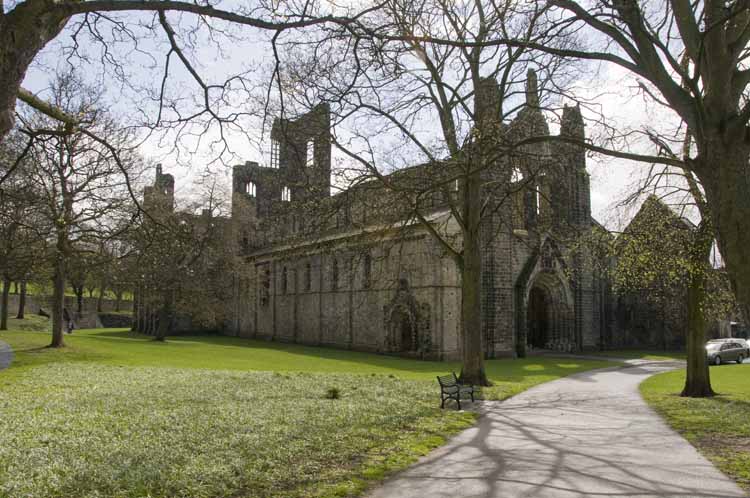
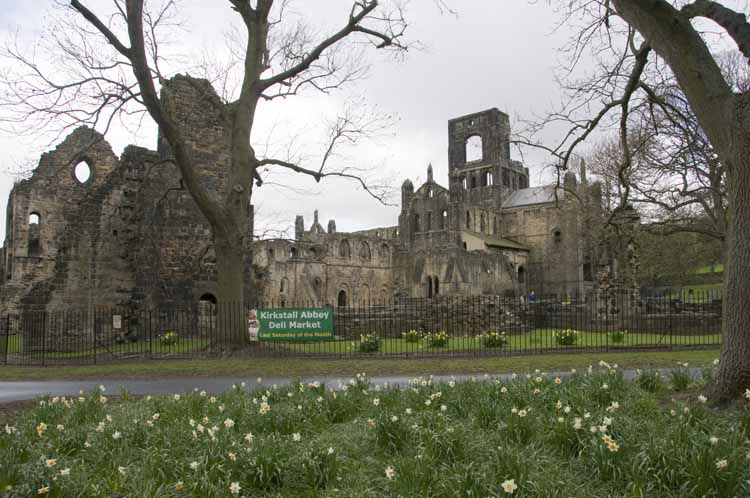
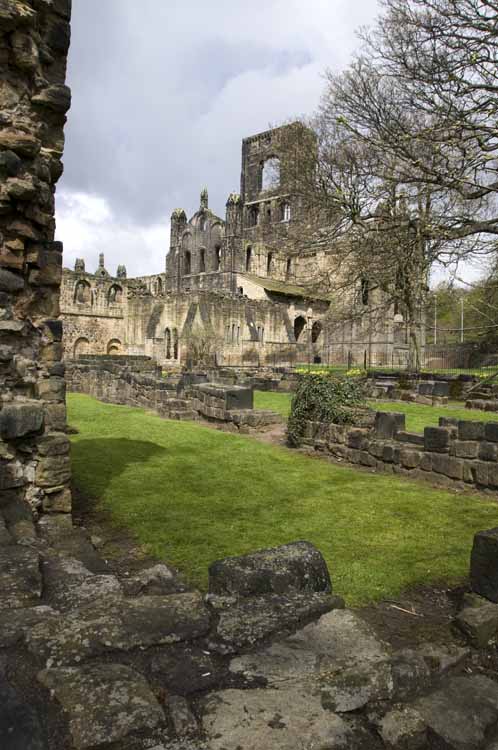
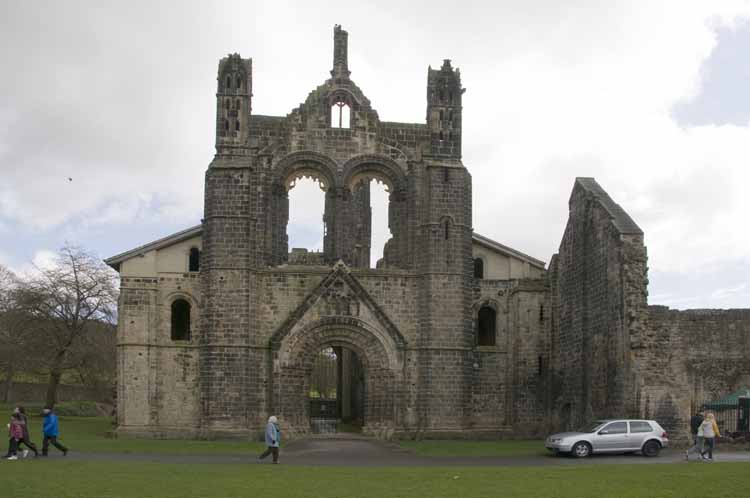
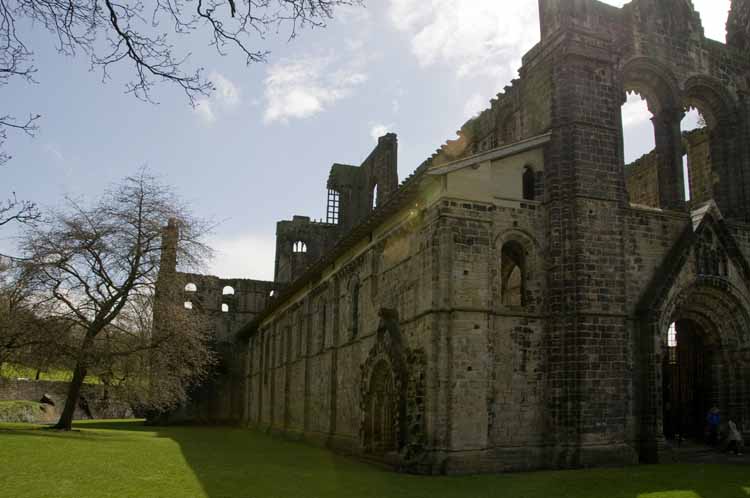
Cistercian Abbey of Kirkstall, Yorkshire.
Kirkstall Abbey, Yorkshire, was founded in 1147 by a group of twelve
monks from Fountains Abbey under the guidance of their prior, Alexander,
colonised the site at Barnoldswick. In 1152 the community relocated to
the present site of Kirkstall, and remained here until the dissolution
of the abbey in 1539. The abbey buildings escaped the wholesale
destruction and plunder that occurred elsewhere; most were left standing
and used for agricultural purposes; this is perhaps why Kirkstall is now
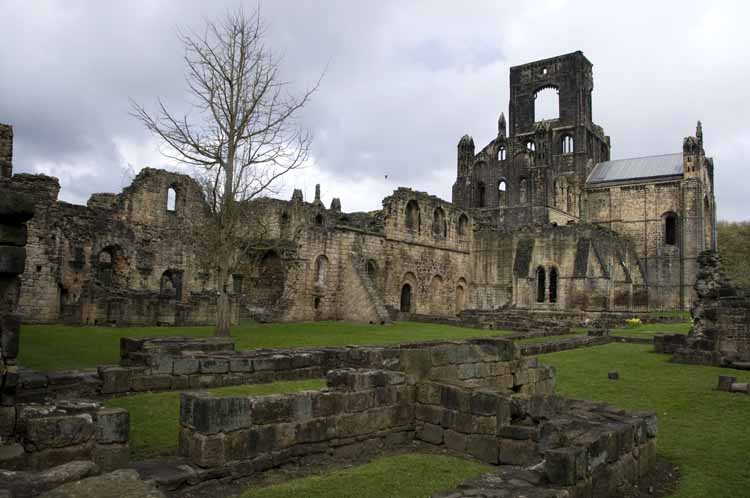
the most complete set of Cistercian ruins in Britain. Kirkstall was
founded by Henry de Lacy, baron of Pontefract, who was one of the
leading landholders in the North. The abbey’s coat of arms, however, is
actually based on those of the Peitivin family, who gave the monks the
site at Kirkstall. Like most other Cistercian abbeys in England, the
twelfth century was for Kirkstall a time of growth and expansion, when
the community developed the abbey precinct and acquired lands and
holdings. From the thirteenth century patronage waned and the history of
the abbey was marked by highs and lows. The Kirkstall monks, like their
Cistercian contemporaries, were embroiled in legal wrangling over their
own lands and rights, they were caught up in business relating to the
state and the Order, and were affected by social and economic problems
that swept the country such as the Black Death, wars and taxation.
Nevertheless, the monks made a significant contribution in the areas of
trade, industry and technological innovation. The lion’s share of the
building work at Kirkstall was completed before the end of the 12th
century, and the chief buildings were finished during Alexander’s abbacy
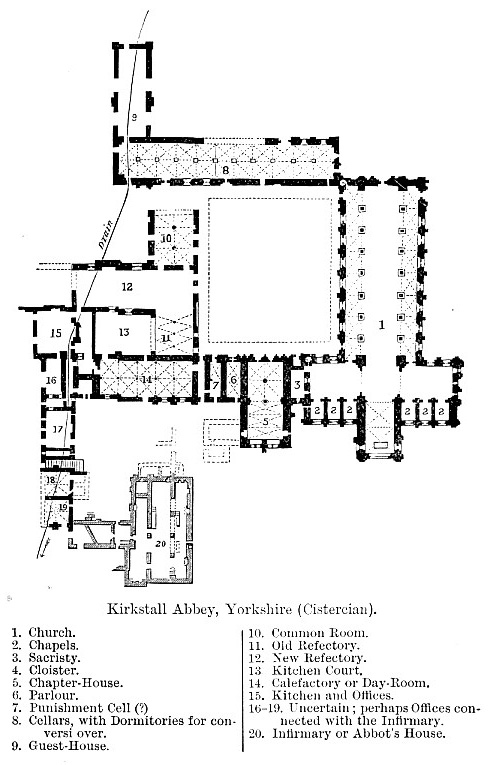
(1147-82). The Foundation History of the house explains that the church,
monks’ dormitory and refectory, lay-brothers’ dormitory and refectory,
chapter-house, cloister and other necessary offices within the abbey
were all built in wood and stone, and covered with fine tiles made of
fired clay and stone slabs known as ‘thackstones’; remains of both types
of roofing material have been found. In the fifteenth century the roofs
were recovered with lead sheets. The community quarried Bramley Fall
stone, a hard, coarse-grained granite, which was resistant to bad
weather. It was transported from quarries across the river. Remains of
the wooden jetty where the stone was landed have been recovered, as well
as several slabs that must have been dropped during transportation. As
Alexander endeavoured to conserve the abbey’s woods, timber was sought
elsewhere. The monks and lay-brothers worked together to erect the
buildings, and Henry de Lacy himself laid some of the foundation stones
in the church, financing the remainder of the work. Skilled stonemasons
were brought in to complete the carving.(6) Excavation of the site in
the 1950s recovered traces of a twelfth-century forge which may have
been used in the construction of the abbey. The building-work was not
only laborious and time-consuming, but expensive, and in 1186 Kirkstall
was amongst the eight Yorkshire houses that owed Aaron, the Jew of
Lincoln, the combined sum of 6400 marks. Kirkstall is
relatively well represented by a wide range of surviving sources. The
Foundation of the Abbey of Kirkstall, dates from the early thirteenth
century and survives only in an early fifteenth-century copy now in the
Bodleian Library, Oxford. The first part of this is a key source for the
early history of the abbey, as it contains a full account of the
foundation of the house and the first five abbots; this covers the
period from 1147 to 1210. This section was probably written by Hugh of
Kirkstall, who became a monk of Kirkstall c. 1183-4, and also wrote the
Foundation of Fountains Abbey. The second part of The Foundation of the
Abbey of Kirkstall simply lists the nine abbots who presided over the
abbey from 1210-84. The third and final section includes important
details concerning the history of the abbey in the late thirteenth and
early fourteenth centuries. It contains a miscellany of information
relating to the financial plight of the house at this time, a list of
their possessions in 1284 and 1301, grants of royal protection and Abbot
Hugh’s lengthy letter to his community from Gascony, reporting on his
meeting with the king. The Dissolution of the monasteries
by Henry VIII brought an end to monastic life at Kirkstall. Following
the completion of the Valor Ecclesiasticus, the survey commissioned by
the king to assess the value of the religious houses in the country, two
royal commissioners, Doctors Layton and Legh, visited 121 religious
houses in the North. They travelled over one thousand miles between
spring 1535 and autumn 1536 to compile a report on the state of the
religious life in the North, based on five pieces of information: the
chastity of the monks, evidence of the veneration of relics, the
financial state of the house, the name of the founder, whether any
members of the community would agree to give up the religious life to
take their place, once more, in secular life. During this grand tour of
the North, Layton and Legh gained a reputation for their unpleasant
manner and rigorous questioning. The couple arrived at Kirkstall after
their visitation of Fountains and Ripon, and reported three cases of
sodomy, veneration of an object said to be the girdle of St Bernard and
promoted as an aid for women in child-birth, and an annual income of
£329. The founder at this time was the king. These findings were
recorded in the infamous ‘Black Book’ which was read out to Parliament
in 1536 as evidence of the poor state of religious life. This paved the
way for the first phase of the dissolution, the suppression of religious
houses with an annual income under £200. Kirkstall, like most of the
Cistercian houses in the North, escaped this first stage of suppression
but finally surrendered in November 1539.
Sources:
https://cistercians.shef.ac.uk/kirkstall
https://www.1902encyclopedia.com/A/ABB/abbey-13.html