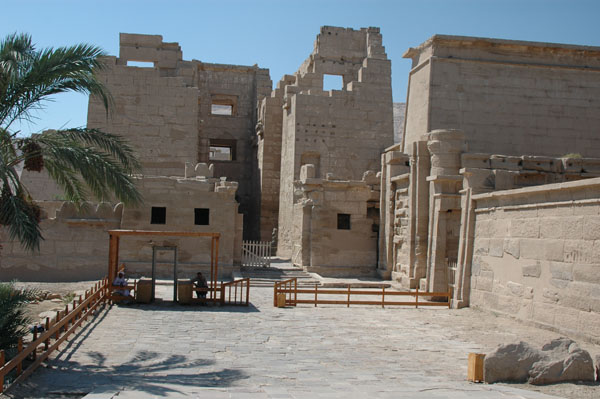
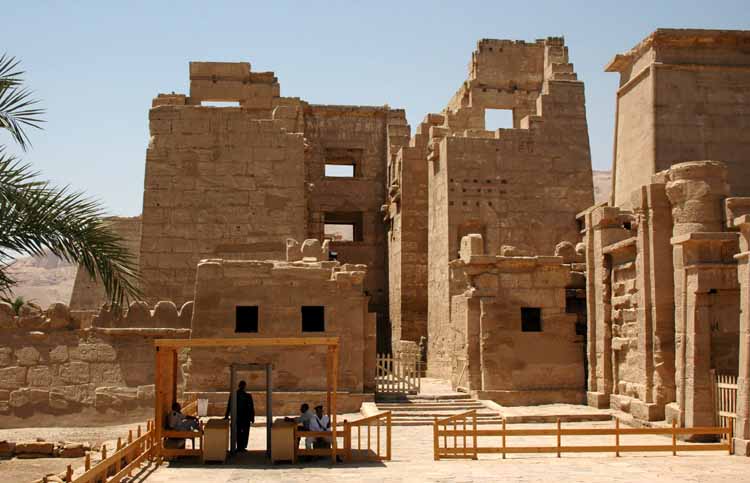
Migdol, or Migdal, is a Hebrew word (מגדּלה מגדּל , מגדּל מגדּול) which means either a tower (from
its size or height), an elevated stage (a rostrum or pulpit), or a raised bed (within a river). Physically, it can mean
fortified land, i.e. a walled city or castle; or elevated land, as in a raised bed, like a platform, possibly a lookout.
Figuratively, it has connotations of proud authority which suggest that Ramesses III used this as a 'statement' of
authority and control.
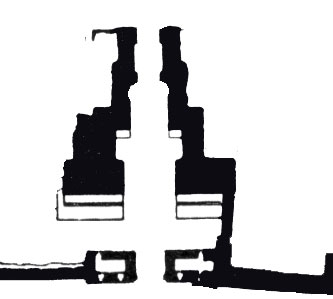
The Migdol is part of the temple complex's entrance. The plan shows how it's layout may have been in the
20th Dynasty, during Ramesses III's reign. The entrance is approached over a causeway and is thorough a flanking wall
with small structure to its left and right. The flanking wall is crenulated in the style of a fortress.
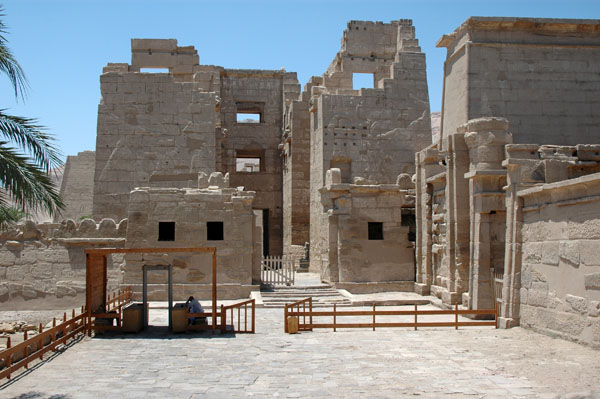
 The Temple of Ramesses III is the best preserved among all temples of Thebes, and
its decorated surfaces amount to 7,000 square meters. The structure of the Temple and its iconographic system are
similar to those of the Ramesseum, although it can hardly equal the elegance of its forms and the balance of dimensions.
In front of the first pylon is a tower built in the form of a Migdol (a military fortress in Asia Minor) which gave the
Temple the aspect of a fortress and had protective functions in the large wall surrounding the Temple.
The Temple of Ramesses III is the best preserved among all temples of Thebes, and
its decorated surfaces amount to 7,000 square meters. The structure of the Temple and its iconographic system are
similar to those of the Ramesseum, although it can hardly equal the elegance of its forms and the balance of dimensions.
In front of the first pylon is a tower built in the form of a Migdol (a military fortress in Asia Minor) which gave the
Temple the aspect of a fortress and had protective functions in the large wall surrounding the Temple.