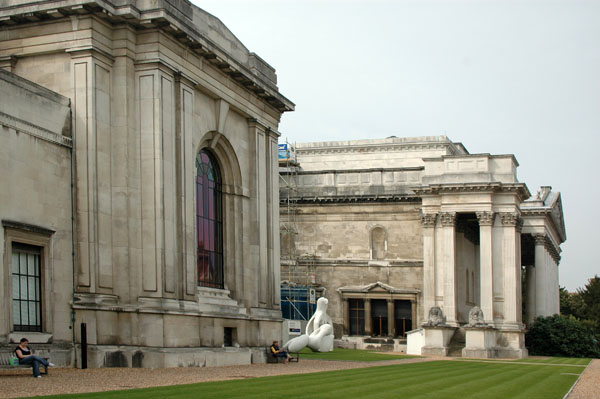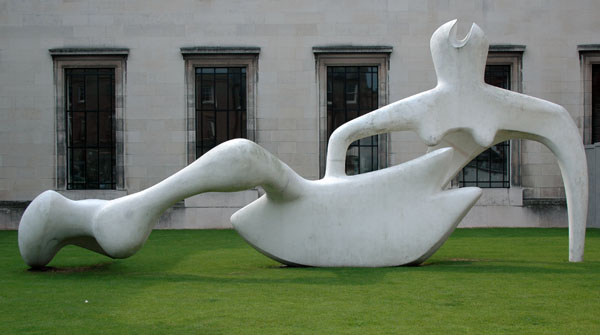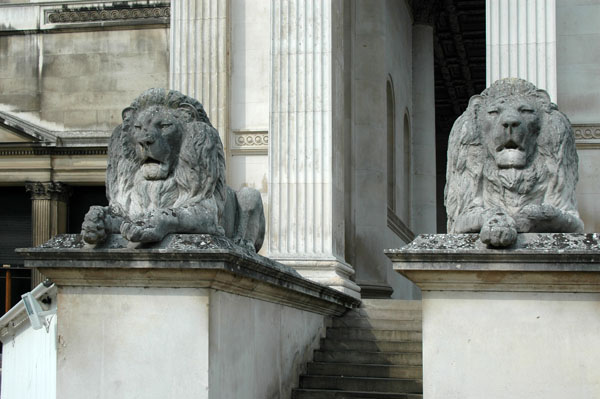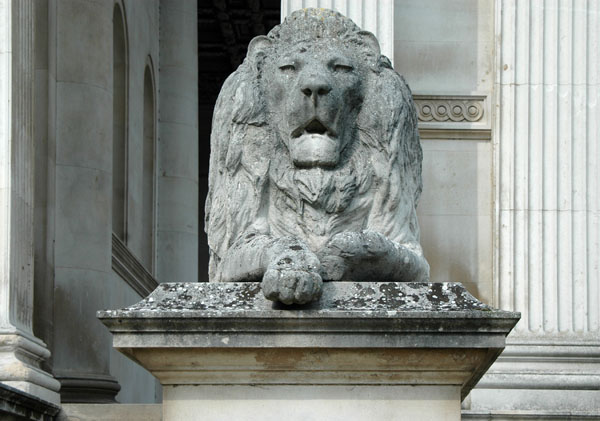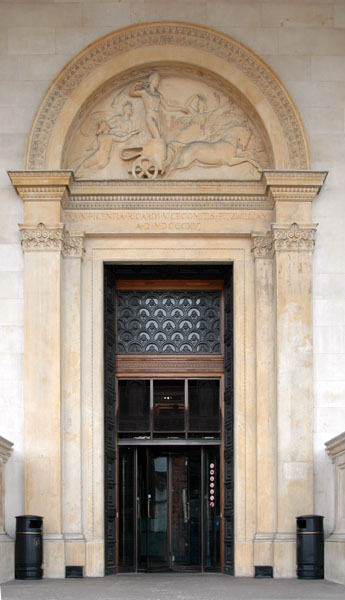
The Fitzwilliam Museum, Trumpington Street, Cambridge, UK
The museum was founded in 1816, by a bequest of the 7th Viscount Fitzwilliam to the University of Cambridge, the Fitzwilliam Museum houses world-class collections of works of art and antiquities spanning centuries and civilisations. Highlights include sculpture, furniture, pottery, oriental art, paintings, drawings and prints, illuminated, literary and music manuscripts, antiquities from Egypt, Greece and Rome, coins and medals and a fine collection of 20th century art.
The collections of the Department of Antiquities has excellent galleries displaying Ancient Egyptian artefacts and has recently been re-opened. The objects are designed to show a representative range of items and include stone and wooden coffins to seal-stones, from painted pottery to marble portraits, jewellery, figurines, fabrics , cuneiform tablets and ivory inlays. The collections have grown gradually as the result of excavations, gifts, bequests and purchases between 1818 and the present day and the Museum's web site has extensive information about the items, including those in the reserve collection. Major contributions to the Museum's Egyptian collection have come from the EES and Gayer-Anderson.
Entrance Hall
The competition to select an architect to design a new building for the Fitzwilliam Museum on its present site,
acquired from Peterhouse in 1823, was initiated in 1834 and won by George Basevi (1794-1845) in late 1835. The
foundation stone of the new Museum was laid on 2 November 1837.
The decision that the Museum would be approached up a flight of steps leading to a great Corinthian portico led to
serious problems in planning its Entrance Hall, which was placed in effect at a mezzanine level, requiring steps up to
the first floor and down to the ground floor.
In Basevi's first solution the space occupied by the present Entrance Hall would have incorporated a Keeper's Office to
one side and a Porter's Room on the other, while the Hall itself, much smaller than the executed scheme, had two flights
of ascending stairs, flanked by a descending flight which split three ways at a landing in the centre of the present
West Asiatic Gallery.
Before his tragic death by a fall through the floor of the west tower at Ely Cathedral in 1845, Basevi had changed his
mind more than once about the conformation of the staircases, being tempted by the alternative of a central ascending
stair flanked by two descending flights. When the Museum was first opened in 1848 the Entrance Hall was unfinished and
undecorated and visitors entered through the basement.
Basevi's successor as architect, Charles Robert Cockerell (1788-1863), proposed a central ascending staircase flanked by
two descending staircases. He also conceived the central dome and the treatment of the ceiling, replacing Basevi's
relatively austere treatment with richly modelled ornament and his rectilinear coffers with arched vaults. In 1870,
Matthew Digby Wyatt (1820-1877) who had in 1865 designed Addenbrooke's Hospital opposite, and was in 1869 the first
Slade Professor of Art, proposed an apse extending under the portico as a means of extending the cramped Basevi/Cockerell
Entrance Hall, which was still unfinished. This suggestion was not approved.
- Finally Edward M Barry (1830-1880) son of Charles Barry (1795-1860), the architect of the
Reform Club and of the Palace of Westminster, was called in. His solution completed in 1875, was to sacrifice the
Keeper's Office and the Porter's Room, putting in their place twin stairs to the lower galleries, and thus opening out
the centre of the Entrance Hall. The decorations of the new Entrance Hall cost the not inconsiderable sum of £23,392.
The Entrance Hall was originally intended to serve, at landing level, as a sculpture gallery, and the central presence of Venus Verticordia by John Gibson (1790-1866), sculpted in Rome for Joseph Neeld in 1850 and given by the Friends of the Fitzwilliam in 1975, is highly appropriate. The position was earlier occupied by a statue of Albert, Prince Consort, Chancellor of Cambridge University from 1847 to 1861 by J H Foley (1818-1874) which is
now at Madingley Hall. On the landing are a number of marble neo-classical busts and sculptural groups.
- Source: Pamphlet from the Museum, Simon Jervis, May 1973.