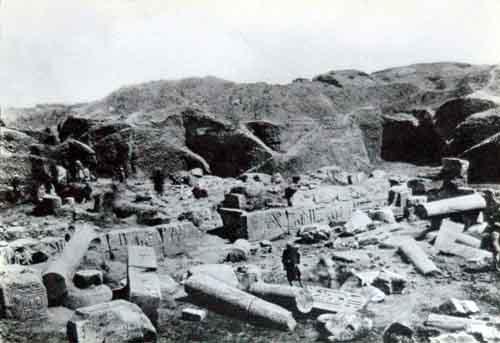
Temple of Herishef at
Heracleopolis
The remains of the ancient city of
Heracleopolis (Ehnasya) were first excavated by Edouard Naville
for the Egypt Exploration Fund in 1890-1891. He found a
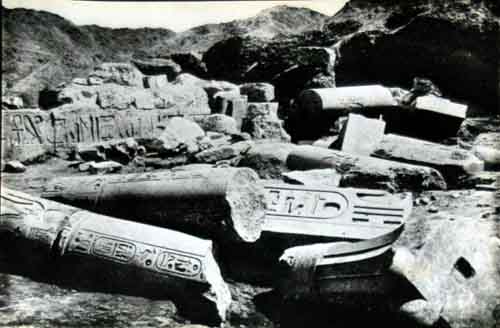
rectangular hall with six fallen granite columns at it's front.
It was thought that this was all that remained of the temple
of Herishef. The six columns were given to the BM,
Boston, Adelaide, Manchester, Bolton and Philadelphia.
More recently the temple has been excavated by the Spanish
Archaeologist José López.
In 1903-4 Sir William Matthew Flinders
Petrie re-excavated part of the ancient town of Heracleopolis,
discovering that there had been more than one temple on the
site. The earliest temple was built by 12th Dynasty kings
Senusret II (Khakheperra, 1877-1870 bc) and Amenemhat III
(Nimaatra, 1831-1786 BC). The temple was re-built and enlarged in
the 18th Dynasty (1550-1295 bc) and another large re-building
was undertaken by 19th Dynasty Ramesses II (Usermaatra Setepenra,
1279-1213 BC). Ramesses re-used pink granite columns from
the 12th Dynasty temple, they were re-carved with scenes and his
name and erected as part of the portico of his temple.
Naville found 6 columns but Petrie estimated that 8 columns
would have been required. The temple was dedicated to the
ram-headed god Herishef, whose main temple and cult-centre was
at Heracleopolis.
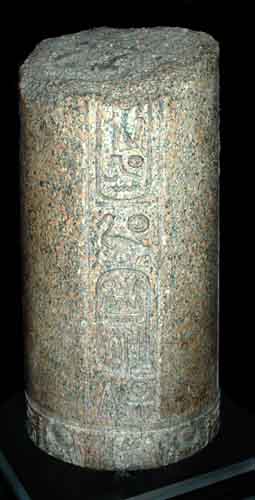
The two fragments of a column that
Bolton received weigh about 1½ tons each and are displayed in
two pieces. Originally the column were each 17 feet tall.
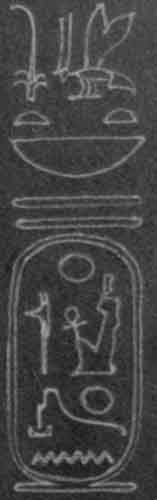
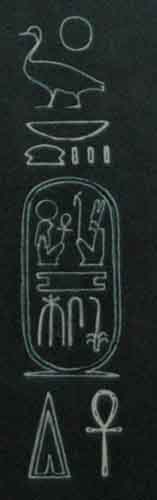
On the column are deeply cut cartouches of Ramesses II.
Also the column has a further cartouche marked out by the
craftsman which would have represented the names and
titles of Merenptah (Baenra, 1213-1203 BC) - who was Ramesses II's 13th son and eventual successor.
|
||||
|
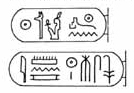
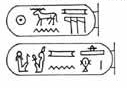
- The earliest structures in the temple at Hnes date from the Middle Kingdom (12th Dynasty). There is a reference from this period to the temple in a written saga known as the 'Eloquent Peasant' - in his fourth attempt to obtain redress for the unwarranted seizure of his donkeys and the goods they were carrying, the peasant comes across the official to whom he has been putting his complaints coming out of the temple of Herishaf. During the New Kingdom the temple at Hnes was greatly enlarged - especially under Ramesses II who was responsible for monolithic granite columns with palm-leaf capitals decorating the Hypostyle Hall. It is from that area that the exquisite gold miniature statuette of Herishaf in the 'Atef' crown, now in the Boston Museum of Fine Arts, was discovered. This figurine gives the name of Peftuaubast, the ruler residing at Hnes, at the time (about 734 BC) of the invasion of Egypt by the Sudanese King Piye. Peftuaubast sided with Piye in his campaign of conquest, acknowledging him as his overlord and sending him tribute.
 Herishaf
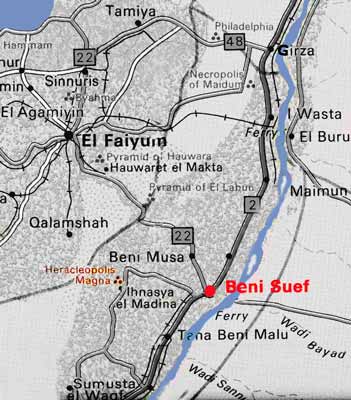
(aka Heryshaf) is a Ram-god with his cult centre at Ihnasya
el-Medina on the west bank of the Nile near Beni Suef. His cult is
mentioned references as early as the 1st dynasty in the Old Kingdom
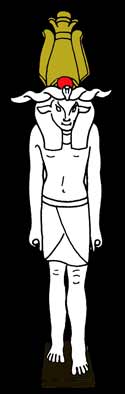
on the Palermo Stone. In reliefs and statues Herishaf is shown as
having an anthropomorphic (man-like) body in a pharaonic stance and
wearing the royal kilt, while his head is that of a long-horned ram.
His association with Osiris leads to his wearing the 'Atef' crown
and his connection with Re results in the adoption of the sun disk
surmounting his horns.
Herishaf
(aka Heryshaf) is a Ram-god with his cult centre at Ihnasya
el-Medina on the west bank of the Nile near Beni Suef. His cult is
mentioned references as early as the 1st dynasty in the Old Kingdom
on the Palermo Stone. In reliefs and statues Herishaf is shown as
having an anthropomorphic (man-like) body in a pharaonic stance and
wearing the royal kilt, while his head is that of a long-horned ram.
His association with Osiris leads to his wearing the 'Atef' crown
and his connection with Re results in the adoption of the sun disk
surmounting his horns.
Herishaf means 'he who is upon his lake', referring probably to the sacred lake in his temple, which in Egyptian religious concepts is an architectural attempt to recreate the primeval waters. So Herishaf is envisaged as emerging from the primal matter at the beginning of time. Inscriptional evidence is scant, so it is not possible to totally accept the attractive theory that 'he who is upon his lake' is the lotus plant arising out of the waters to open up and reveal the young sun-god. The Greek author Plutarch localized Herishaf's name as Arsaphes and gives its meaning as 'manliness'. This is probably not to be taken as a general observation on the procreative inclinations of the ram, but more likely as deriving from an original (and typical) Egyptian play on words: between shaf meaning 'his lake' and a word of similar consonantal sound, translating as 'respect' or 'manly dignity'. In Greek terms Herishaf became 'Herakles'. Accordingly the name of the site most sacred to the god, called lines in Ancient Egypt (modern Ihnasya el-Medina), is given in Greek texts as 'Herakleopolis Magna' or 'town of Herakles'. Hnes was the capital city of northern Egypt during the years separating the Pyramid Age from the Middle Kingdom (known as the First Intermediate Period). It is at this time that the relatively locally-based god became enhanced with a universality accompanying his identification as the 'Ba' (soul) of Osiris and the 'Ba' of Re.
 The
fullest description of the god is found on a stela originally set up
at Hnes but discovered in the temple of Isis at Pompeii and now in
the Naples Museum. It is inscribed with the career of Somtutefnakht
under the last native Egyptian pharaoh, through the second Persian
Domination of Egypt beginning under Artaxerxes III Ochus (343-338
BC) in 341 BC to the conquest of Alexander the Great in 332 BC.
Somtutefnakht, in his view guided by Herishaf, collaborated with the
Persians. The god also ensured that he remained unharmed during the
turbulent period of the Greek invasion when, according to the
inscription, there was colossal slaughter. Herishaf then appears to
Somtutefnakht in a dream advising him to return to his home town of
Hnes and serve in the temple. Alone and through great peril on land
and sea journeys, he reaches Hnes without even the loss of hair.
The
fullest description of the god is found on a stela originally set up
at Hnes but discovered in the temple of Isis at Pompeii and now in
the Naples Museum. It is inscribed with the career of Somtutefnakht
under the last native Egyptian pharaoh, through the second Persian
Domination of Egypt beginning under Artaxerxes III Ochus (343-338
BC) in 341 BC to the conquest of Alexander the Great in 332 BC.
Somtutefnakht, in his view guided by Herishaf, collaborated with the
Persians. The god also ensured that he remained unharmed during the
turbulent period of the Greek invasion when, according to the
inscription, there was colossal slaughter. Herishaf then appears to
Somtutefnakht in a dream advising him to return to his home town of
Hnes and serve in the temple. Alone and through great peril on land
and sea journeys, he reaches Hnes without even the loss of hair.Herishaf is described by the epithets:
'king of the Two Lands' 'ruler of the riverbanks'
These titles ascribe the sovereignty of Egypt to Herishaf. Solar symbolism is used in the stela to invoke Herishaf as a manifestation of Re - his eyes are the sun disk and the moon. Herishaf is Atum who is here associated with the sacred 'naret' tree, which could be a maybe a sycamore, of Hnes. As a primeval force Herishaf is proclaimed as creator of all life from the north wind which he breathes forth from his nostrils.
 Picture
2
Picture
2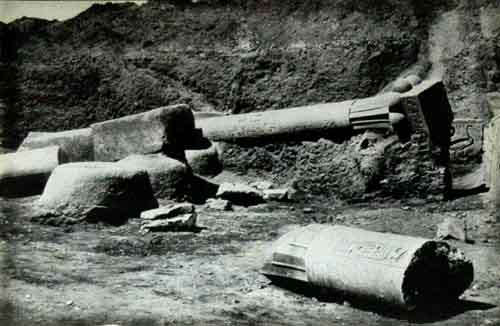 Picture
3
Picture
3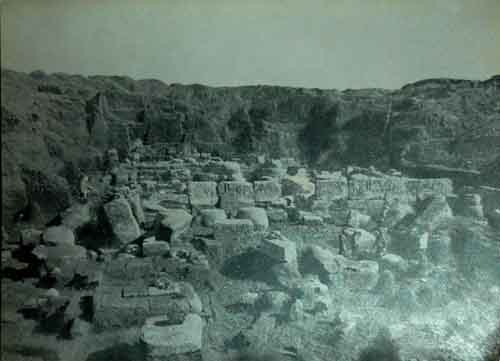 Picture
4
Picture
4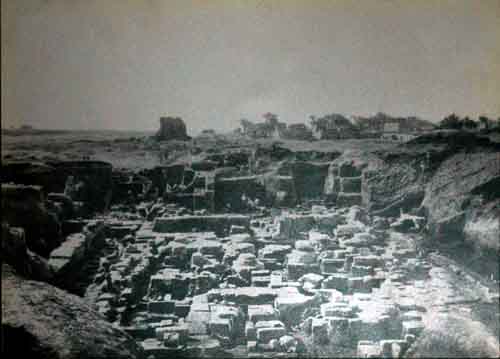 Picture
5
Picture
5