|
|
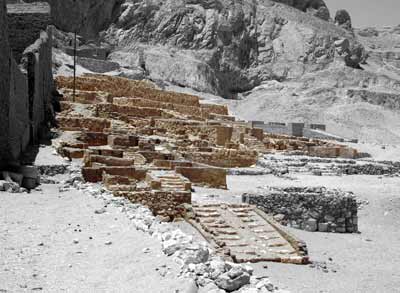
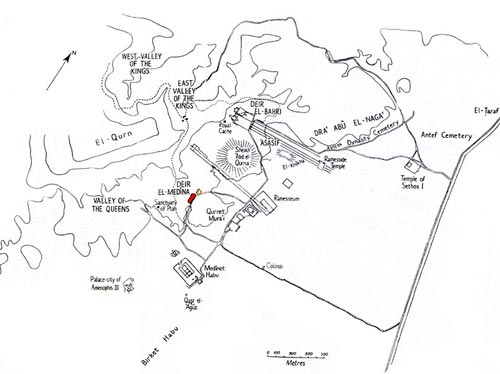 The worker's village at Deir el Medina is one of the most thoroughly documented communities in the ancient world. It is located west of modern Luxor on the west bank of the Nile about half a mile beyond the cultivated land bordering the river and between the Valley of the Kings and the Valley of the Queens. The village is in the southern part of the Theban necropolis in a valley behind Gurnet Murai hill. The major path from the village proceeded north from its western foothills along the top of the cliffs, that surround Deir el Bahri, to the place where workmen made a small settlement for themselves before the path descended to the Valley of the Kings. Workmen and their families left a record of village life that spans almost four hundred years and parallels much of the history of the New Kingdom dynasty. Surviving records shed little light on the major events, rather they talk of everyday life - work, money, people, education, legal and religious matters. The village is located deep within a valley and is not visible from most key vantage points in the area. The plan of the village evolved over time until its final 'shape' shown here.
|
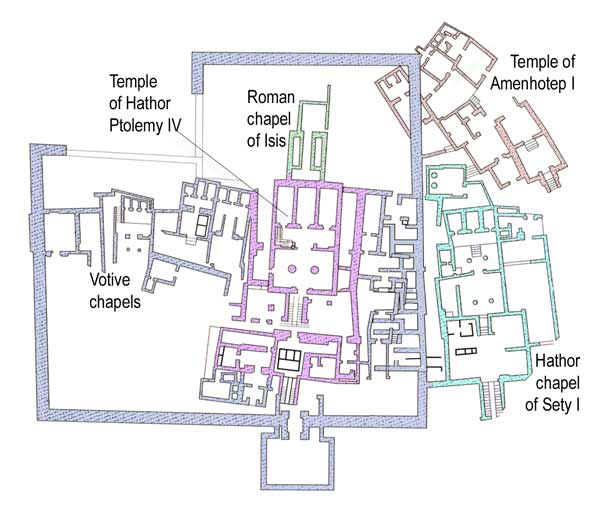
A small valley was the area where a community of workmen who constructed the royal tombs in the Valley of the Kings had their village. On the north side of the village several temples were built, the largest of which was begun by Amenhotep III and almost completely rebuilt and expanded in later times - long after the village had been deserted. The temple of the cult of Amenhotep I (1525-1504 bc) stands on the terrace above the Ptolemaic temple at its north corner. The original structure was small and the surrounding walls were added later.
|
|
|
 | ||
|
Ptolemaic
temple of Hathor
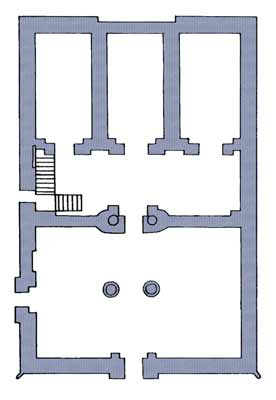
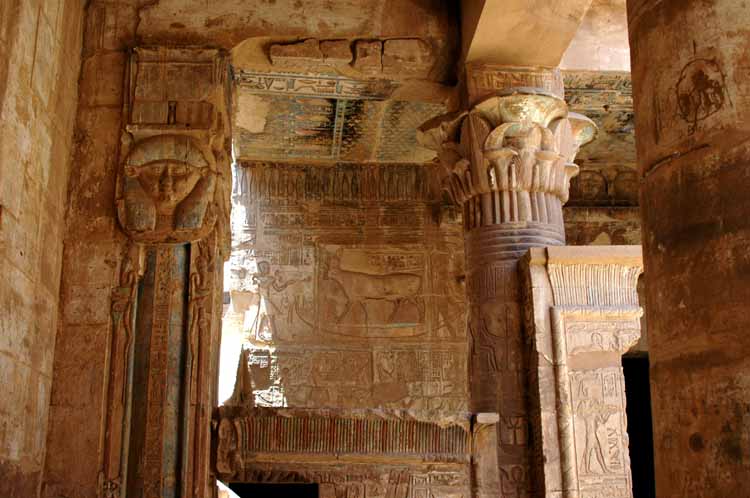
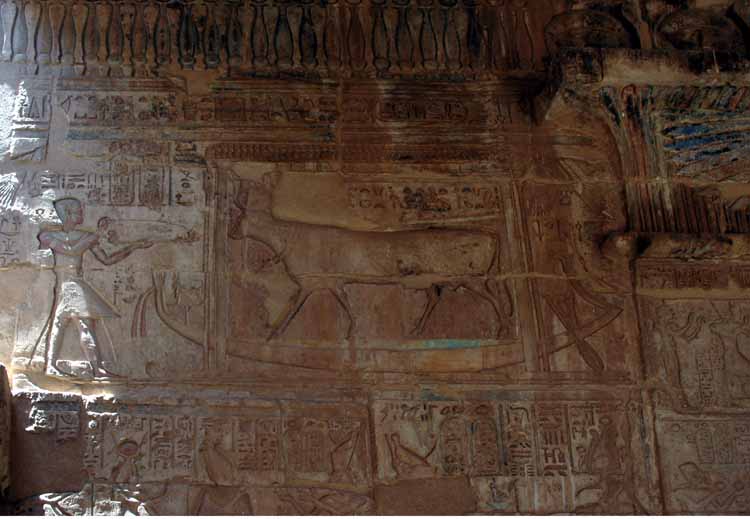
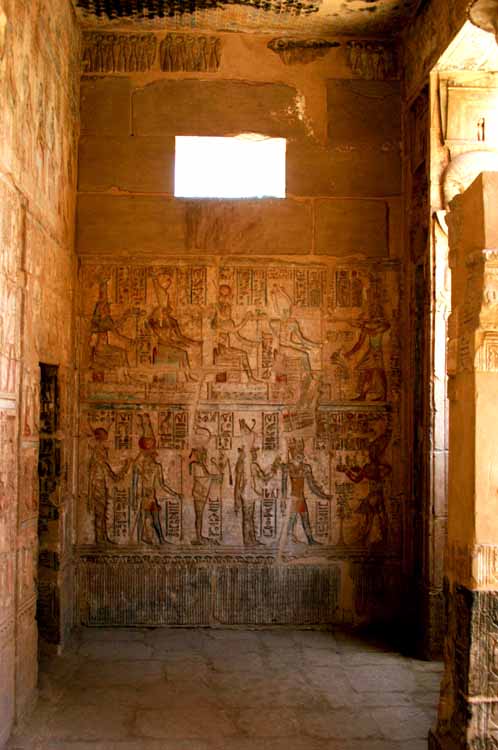
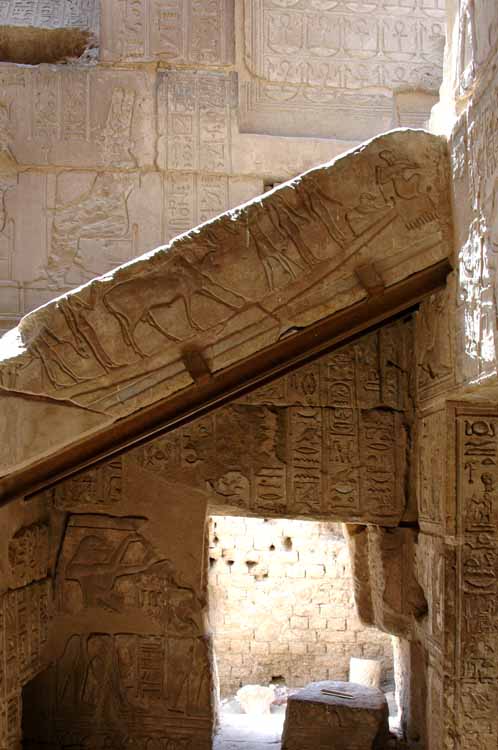
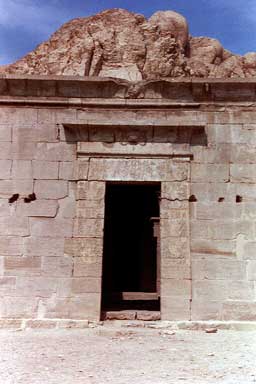
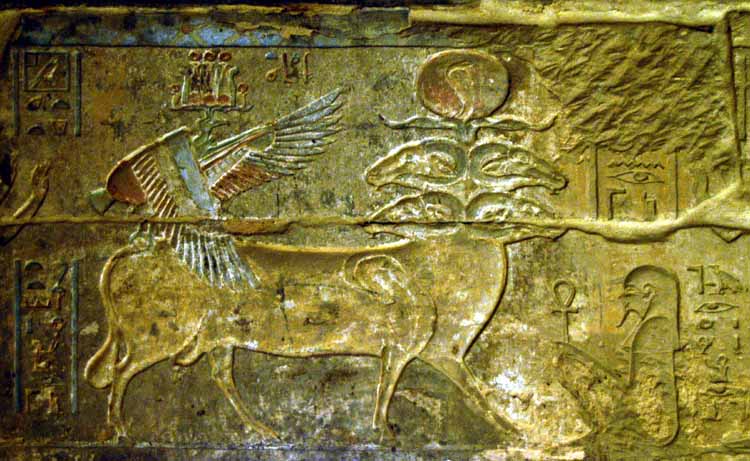
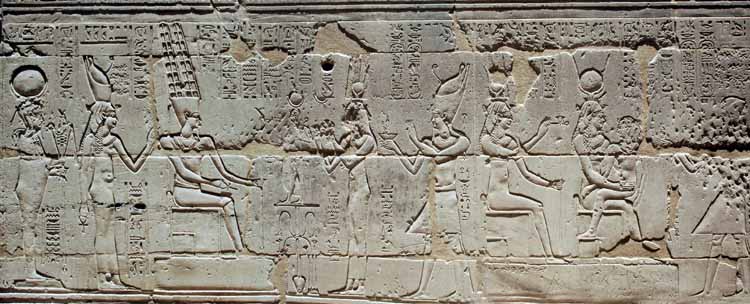
The compound embraces the sites of earlier temples and the remaining Ptolemaic temple itself is fronted by a staircase of Ramesses II. The temple, built in the 3rd century by Ptolemy IV and enhanced by Ptolemy VI and also by Ptolemy XI. The temple is in near perfect condition and is nestled within the surrounding topography. The temple's style is very simple, as the plan shows. The columned hypostyle hall opens into a narrow vestibule before three sanctuaries. The hypostyle hall has two pillars. The vestibule, which included the stairway to the ceiling, has scenes of Ptolemy IV offering to Hathor in the form of a Cow and to the right he is offering to various gods. The three sanctuaries, from left to right, are dedicated to Amun-Sokar-Osiris, Hathor-Maat and Amun-Re-Osiris. Above the middle door, Hathor-Maat, is a relief of the multi-headed Hathor. The Amun-Sokar-Osiris sanctuary has a bass-relief scene of the Osiride judgement. This is more commonly found in tombs than in temples. Here, as in the temple of Hatshepsut at Deir el Bahri, chapels were also dedicated to both Imhotep and Amenhotep son of Hapu. A stairway leads from the left side of the vestibule to the temple's roof.
|
  Hathor was clearly popular with the villages of
Deir el Medina. Many of the women had the title "Songstress of
Hathor" and there were a number of chapels dedicated to her in the
village. Sety I built a temple to her, as did his son Ramesses II.
This was replaced by the present Ptolemaic temple long after the
worker's village had been deserted. Excavation in the temple uncovered a
statue of Mertseger, the snake goddess who was another form of Hathor. Hathor was clearly popular with the villages of
Deir el Medina. Many of the women had the title "Songstress of
Hathor" and there were a number of chapels dedicated to her in the
village. Sety I built a temple to her, as did his son Ramesses II.
This was replaced by the present Ptolemaic temple long after the
worker's village had been deserted. Excavation in the temple uncovered a
statue of Mertseger, the snake goddess who was another form of Hathor.
|
|
|
|
 Directly
to the north of the village is the small Ptolemaic temple dedicated to
Hathor. It is also dedicated to Maat, Amenhotep son of Hapu and to
Imhotep. During the Coptic period it was converted into a
monastery, which ironically gave it protection when other temples were
defaced or destroyed.
Directly
to the north of the village is the small Ptolemaic temple dedicated to
Hathor. It is also dedicated to Maat, Amenhotep son of Hapu and to
Imhotep. During the Coptic period it was converted into a
monastery, which ironically gave it protection when other temples were
defaced or destroyed.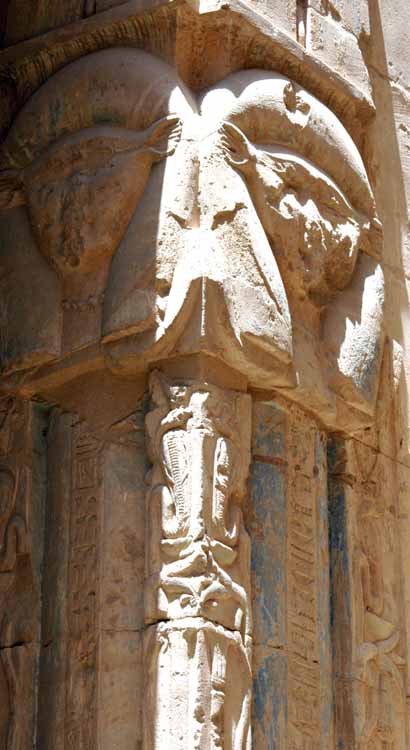
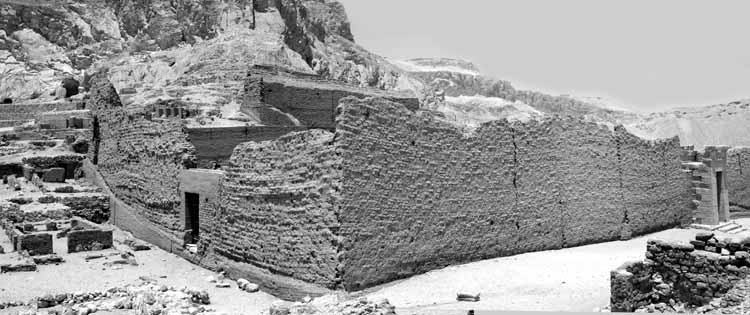 Exterior
of the Enclosure Wall Exterior
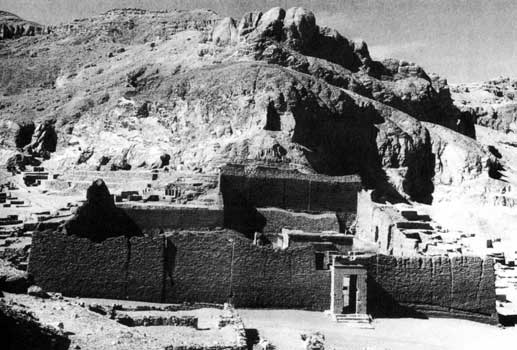
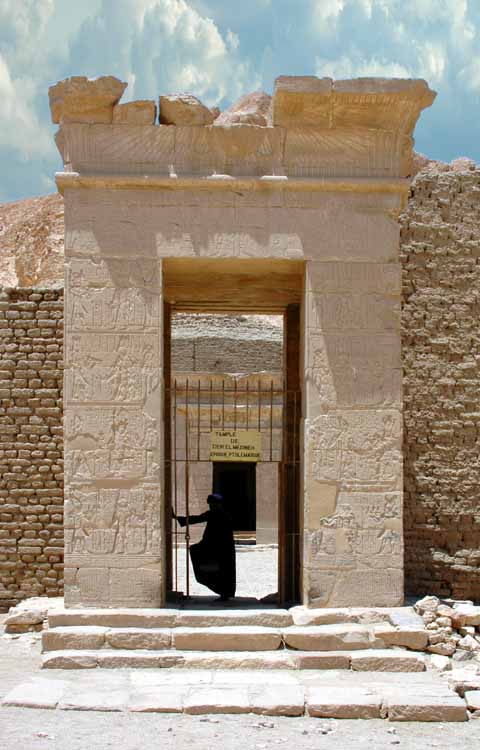
of the Enclosure WallImages of the exterior of the temple enclosure. This mud brick curtail wall was added during the Ptolemaic development, long after the worker's village of Deir el Medina had been abandoned.
|
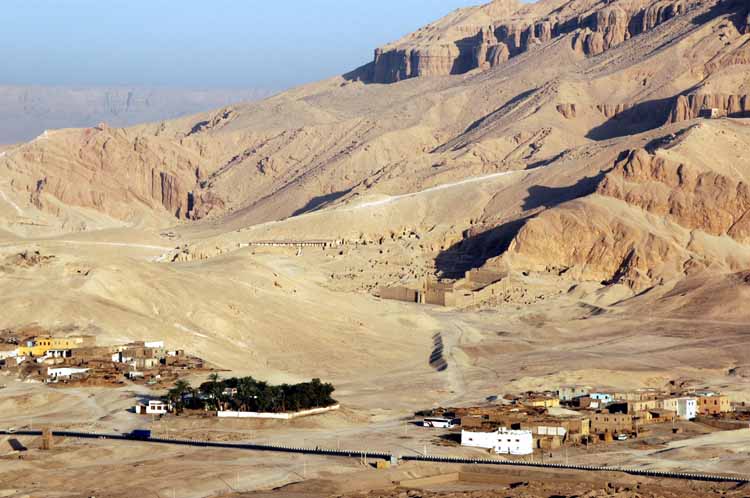
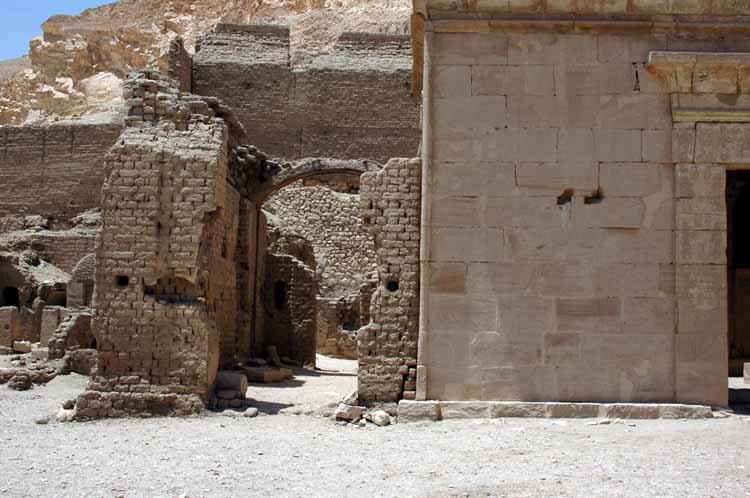
Picture (left) of the temple looking from the east to the west. To the right of the Ptolemaic temple are the remains of the Amenhotep and Sety structures. Picture (right) of the exterior curtail wall's entrance, added during the Ptolemaic re-working of the temple.
|
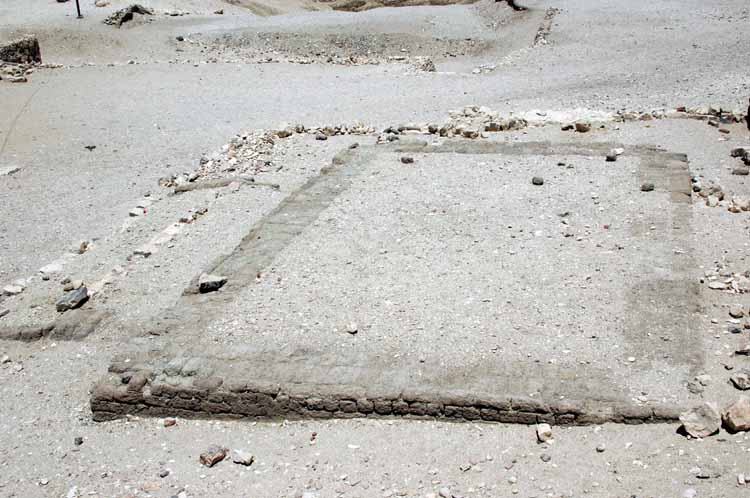 The
base of mud brick wall can be found directly opposite the temple's
entrance. The plan of the temple does show a structure, but this
is approximately 25 feet from the entrance. Dieter Arnolds' "The
Encyclopaedia of Ancient Egyptian Architecture" does show a plan of this
structure and it is referenced as being added during the Ptolemaic
phase. The
base of mud brick wall can be found directly opposite the temple's
entrance. The plan of the temple does show a structure, but this
is approximately 25 feet from the entrance. Dieter Arnolds' "The
Encyclopaedia of Ancient Egyptian Architecture" does show a plan of this
structure and it is referenced as being added during the Ptolemaic
phase. |
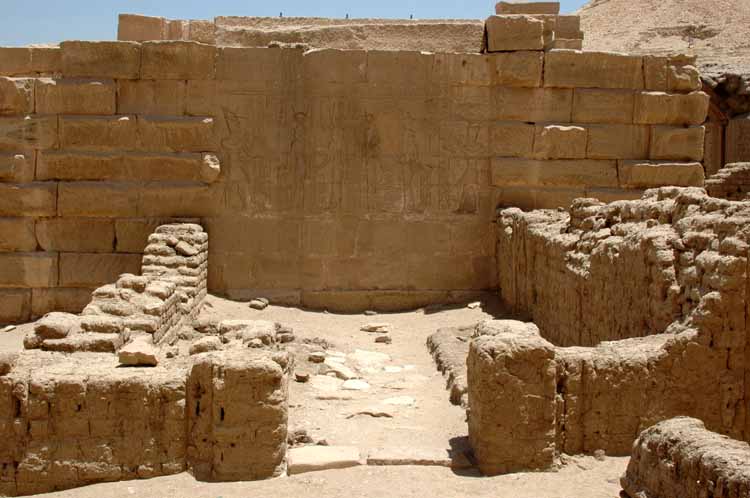 Interior
of the Enclosure Wall Interior
of the Enclosure WallThe temple's interior is enclosed by a Ptolemaic curtail wall made of mud bricks. Inside the interior are a number of votive chapels, like the top picture. Picture 2 shows the interior and the placement of the votive chapels. |
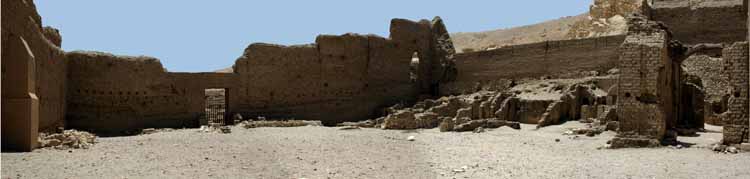 Picture
2 Picture
2 |
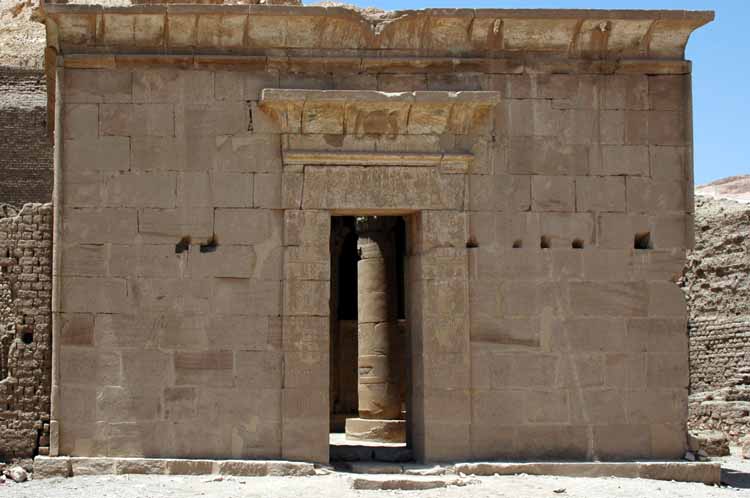 Picture
3 Picture
3This show the exterior of the Temple of Hathor built by Ptolemy IV, and finished by later Ptolemies. |
 Picture
4 Picture
4To the east of the Temple of Hathor is a birth house, constructed during the same phase of development. |
 |
|
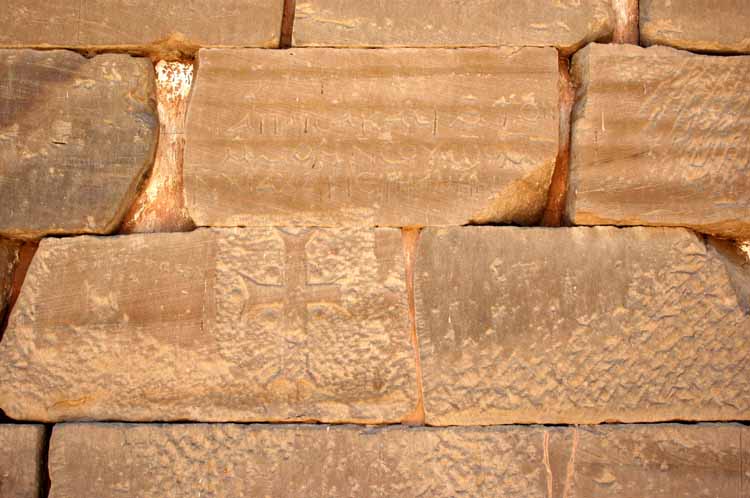
The Ptolemaic temple is in a state of excellent presentation. The temple was used long after the village was deserted. Eventually it was transformed into a Coptic monastery, which it's modern name, meaning 'Monastery of the Town', is formed. Couldn't translate this coptic script. The beginning is Saint but the rest is unclear. |